

Understand traceable coffee: choose more sustainable beans
TL;DR:
- True traceability involves verifiable data at every supply chain stage, not just regional labeling.
- Traceability is essential for accurate sustainability claims and environmental impact measurement.
- Consumers and roasters can improve transparency by examining detailed batch info and asking targeted questions.
Plenty of coffee lovers pick up a bag labelled “single origin” or stamped with a certification logo and assume that means their coffee is fully traceable from farm to cup. That assumption is understandable but often incorrect. A region name on packaging tells you very little about who grew the beans, how they were processed, or what conditions workers faced. Genuine traceability goes several steps further, and understanding the difference shapes every purchasing decision you make as a home barista or enthusiast looking for coffee that matches your values.
Table of Contents
- What does traceable coffee mean?
- Why does traceability matter for sustainability?
- How traceability works in real life
- How to find and choose traceable coffee
- The hidden complexities of traceable coffee: a realist’s view
- Explore traceable coffee and sustainable options
- Frequently asked questions
Key Takeaways
| Point | Details |
|---|---|
| Traceability defined | Traceable coffee lets you follow each step from farm to cup, so you know exactly where your beans come from. |
| Sustainability link | Traceability makes it possible to measure and improve coffee’s environmental footprint, including water and carbon use. |
| Real-world limits | Not all coffee can be fully traced—especially from small farms or complex blends—so ask questions and check details. |
| Choosing better | Look for roasters who share farm information, processing methods, and proof of origin for the most traceable brews. |
What does traceable coffee mean?
Traceable coffee is coffee where verifiable information exists at every major point in the supply chain, from the specific farm or co-operative where the cherries were picked, through processing and export, to the roastery and finally your cup. This is different from knowing a country of origin or even a named region. True traceability means data exists and is accessible.
The coffee supply chain involves many stages. Consider this typical journey:
- Farm level: Cherry picking, often by hand, on a specific plot of land
- Processing station: Wet or dry processing to remove fruit and dry the bean
- Mill and export: Sorting, grading, and preparing green beans for shipment
- Import and quality control: Arrival in the UK, cupping and grading
- Roastery: Roast profiling, batch recording, and dispatch
- Consumer: You, receiving freshly roasted beans with batch or lot information
Each stage is a potential point where traceability can break down. When multiple farms contribute to a single processing lot, or when brokers blend lots together before export, the chain of identity becomes incomplete. This is particularly relevant to understanding business coffee supply explained at scale.
Blending complicates matters further. A blend might use beans from three different origins, each with different levels of documented traceability. The resulting product carries no single traceable identity.
“Smallholder farms under two hectares are hard to geolocate precisely; blending masks traceability; experimental processing such as anaerobic fermentation can overshadow origin in flavour identification; and non-certified organic practices are common but uncertified.”
Processing method also plays a role. A coffee processed using an experimental anaerobic method may taste so distinctive that its regional flavour profile is barely recognisable, making origin verification by taste alone impossible. That is one reason why documentation matters more than sensory impression.
Pro Tip: When reading a bag, look beyond the country name. Check for a farm name, co-operative name, lot number, or producer profile. The more specific the information, the more likely genuine traceability exists behind the product.
Why does traceability matter for sustainability?
With traceability defined, let us look at why it matters for sustainability-minded coffee lovers.
Traceability is the foundation of any credible environmental or social sustainability claim. Without knowing exactly where coffee was grown and how it was produced, it is impossible to accurately measure its carbon footprint, water usage, or labour standards. Sustainability claims made without traceability are essentially unverifiable.
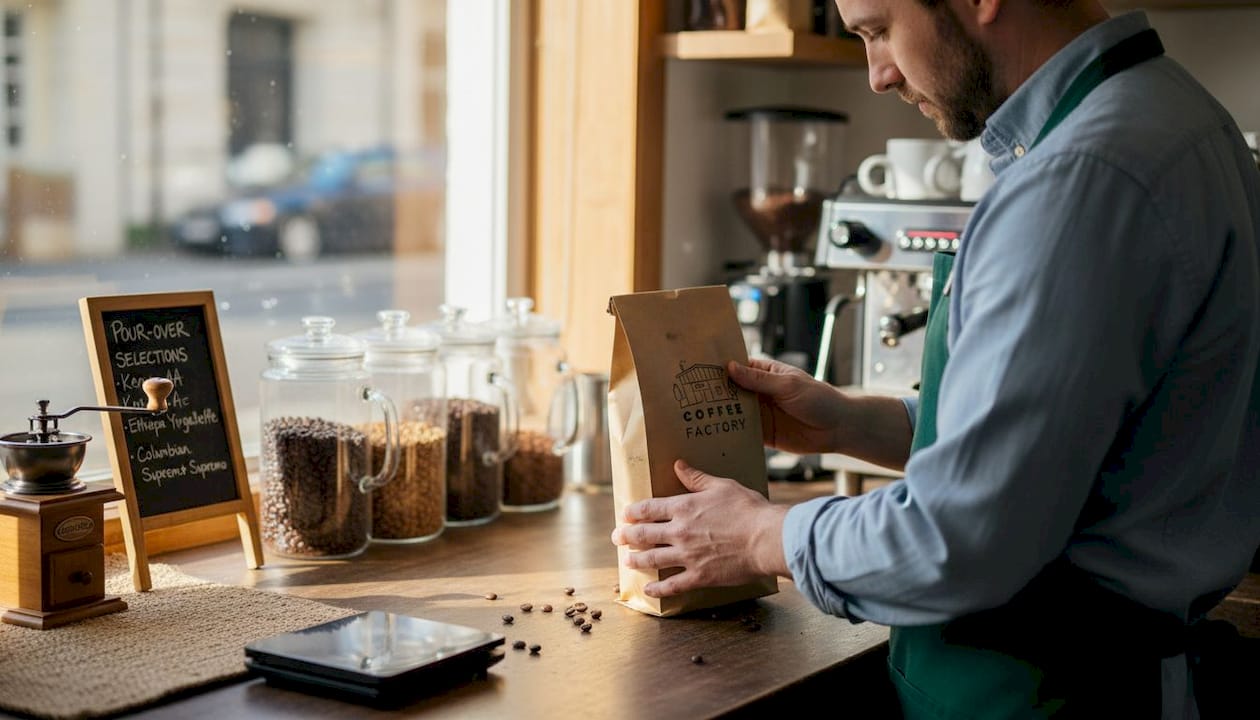
Research into Yemen smallholder specialty coffee carbon footprint provides a useful benchmark. The study found a carbon footprint of 3.14 kg CO2 equivalent per kilogram of green beans, with approximately 90% of that total arising from cultivation itself rather than processing or transport. This level of detail is only possible because the supply chain was traceable enough to collect farm-level data.
Processing method affects not just carbon but water use too. Dry processing, where cherries are dried whole in the sun, uses significantly less water than wet processing, which requires large volumes of water to remove the fruit. Choosing a dry-processed coffee from a traceable source means you can confirm both the environmental method and its origin.
| Processing method | Water use | Traceability impact |
|---|---|---|
| Dry (natural) | Low | Retains origin flavour profile |
| Wet (washed) | High | Can obscure micro-lot identity in communal tanks |
| Honey/pulped natural | Medium | Variable, depends on station practices |
| Anaerobic fermentation | Variable | Often masks regional flavour cues |
New EU regulations raise the bar further. The EU Deforestation Regulation (EUDR) requires farm-level geolocation data and proof that coffee was grown on deforestation-free land for plots over four hectares planted after 2020. This is a significant shift in what counts as documented traceability and will affect imports into the UK market too as supply chains adjust.
Understanding how these issues connect is part of engaging with the sustainable coffee guide for UK enthusiasts. The sustainability practices that roasteries adopt reflect real decisions about which farms they source from and how deeply they invest in supply chain knowledge. Staying aware of specialty coffee trends in 2026 includes understanding how these regulations are reshaping sourcing choices across the industry.
How traceability works in real life
With the reasons established, here is what traceability looks like in practice and where it often falls short.
Consider two coffees side by side. The first is labelled “Colombia, Huila region, Finca El Paraíso, washed, lot 04, 2025 harvest, producer: Diego Samuel Bermúdez.” The second says “Colombia blend.” The first carries enough detail to verify every claim. The second carries almost none.
Real-world traceability often falls somewhere in between. Here is a numbered walkthrough showing how traceability is maintained or lost at each stage:
- Picking: A small farm with one family harvesting their own cherries. Traceability is high. A large estate using seasonal workers from multiple villages picking into shared containers. Harder to assign lot-level identity.
- Processing: Cherries taken to a communal washing station shared by 40 farms. Individual farm identity is typically lost at this point unless the station records intake by producer.
- Milling and grading: Lots sorted and combined by grade and size. Smaller lots may be merged with similar-grade beans to fill export containers.
- Export documentation: Shipping paperwork records country, grade, and sometimes region. Farm-level data is rarely included unless specifically maintained by the exporter.
- Import: Green bean traders may blend lots further to meet buyer volume requirements.
- Roastery: A roastery sourcing directly from an importer who retained lot identity can restore traceability at this stage. A roastery buying commodity-grade beans cannot.
This walkthrough shows why direct trade relationships matter. When a roastery builds a direct connection with a specific farm or co-operative, and that relationship includes documentation, the chain remains intact.
Smallholder farms under two hectares present a specific challenge. These farms are genuinely difficult to geolocate precisely, and their output is often small enough that it must be combined with neighbouring farms to create a commercially viable lot. That does not mean the coffee is poor quality. It means full farm-level traceability may not be achievable in those circumstances.
Understanding coffee storage and processing methods is relevant here too, because how beans are stored and handled after roasting affects the quality of the information that accompanies them. A roastery with rigorous batch records will be able to tell you more than one that operates without documented processes.
Pro Tip: Ask your roaster directly about farm-level detail. A good roaster should be able to tell you the producer name, the processing station, and ideally the harvest year. If they can only offer a country name, that is a clear indicator of limited traceability in their supply chain.
You can also use the guidance in choosing coffee beans to build a sharper eye for what packaging information actually signals versus what is purely marketing.
How to find and choose traceable coffee
Knowing the challenges and benefits, here is a practical framework for finding and selecting genuinely traceable coffee.
Check the packaging carefully. Look for these specific indicators:
- Named producer, farm, or co-operative (not just a region or country)
- Lot or batch number
- Harvest year or season
- Processing method with station name where possible
- Altitude and variety (Bourbon, Gesha, Caturra, etc.)
- QR code or URL linking to producer information
Each additional data point signals greater transparency from roastery to farm. The presence of all of these together is a strong indicator of genuine traceability.
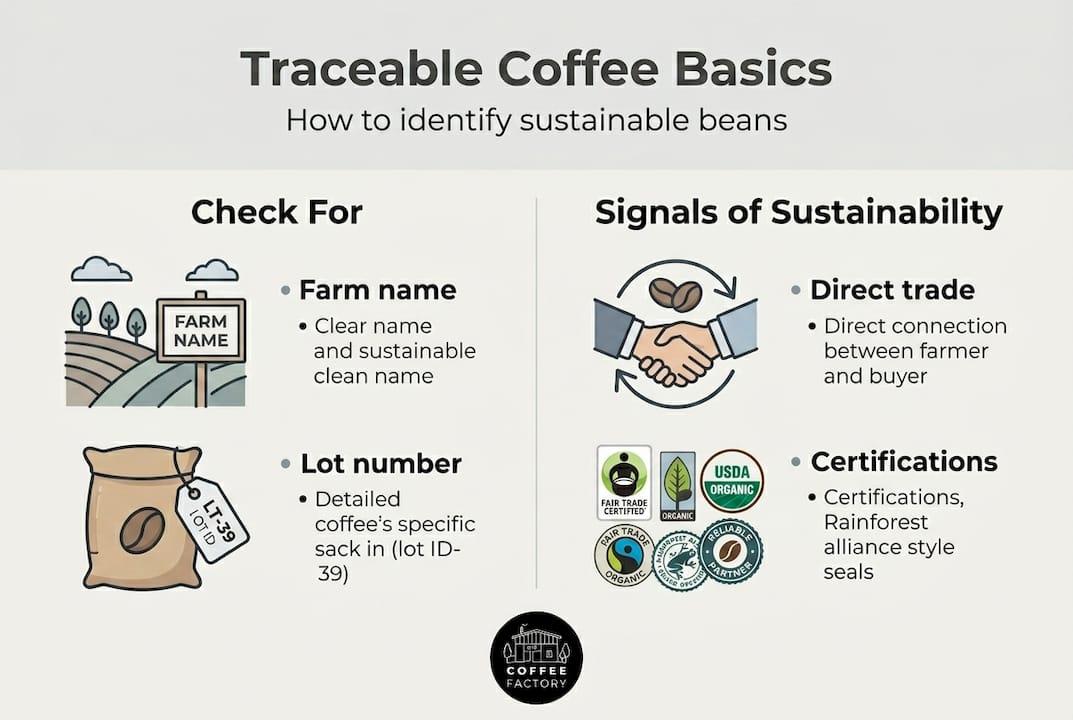
Consider certification schemes, but keep them in context. Certifications like Fairtrade, Rainforest Alliance, and Direct Trade each measure different things. Fairtrade focuses on minimum price guarantees and community investment. Rainforest Alliance covers environmental and social standards. Direct Trade is not a formal certification but indicates a direct sourcing relationship between roaster and producer. None of these certifications alone guarantee full traceability, but they add a layer of verified accountability.
It is also worth noting that non-certified organic practices are common among smallholders who cannot afford the cost of certification. Many farms grow coffee without synthetic inputs but carry no organic label. Traceability and organic certification are genuinely separate categories, and one does not imply the other.
Questions to ask your roaster or merchant:
- Which country and specific region does this coffee come from?
- Can you name the farm or co-operative?
- How is the coffee sourced: direct trade, importer relationship, or spot market?
- Is there a lot number or harvest year documented for this batch?
- Can you provide a producer profile or link to more information?
Pro Tip: Some roasteries now include QR codes on packaging that link directly to producer pages, cupping notes, and even photographs from the farm visit. Where available, use them. They represent the clearest form of consumer-accessible traceability currently on the market.
When exploring single origin coffee impact, keep in mind that single origin is a starting point for traceability, not a guarantee of it. A coffee labelled single origin still requires the full chain of documentation to be considered genuinely traceable.
The hidden complexities of traceable coffee: a realist’s view
Having outlined hands-on tips, let us consider the bigger, messier picture behind traceable coffee.
Traceability is not a binary state. It exists on a spectrum, and most coffee sits somewhere in the middle rather than at either extreme. The industry tends to present traceability as a clean achievement when the reality is that even the most diligent roastery works with incomplete information at some stages of the chain.
Consider micro-lots. These are small, distinct batches from a single plot within a farm, often processed separately to preserve a unique flavour profile. Micro-lots represent the highest form of traceability currently common in specialty coffee. Yet even here, inconsistencies arise. Weather events, staffing at the processing station, and transport logistics can all introduce gaps in documentation that no amount of intention resolves.
Experimental processing methods add another layer of complication. Anaerobic fermentation, carbonic maceration, and extended fruit contact methods are increasingly popular in the UK specialty market. These techniques produce distinctive, often intensely flavoured coffees. But as research confirms, the processing can so thoroughly dominate the sensory profile that origin characteristics become almost undetectable. Traceability in the documentation might be intact, but the consumer experience of that traceability is effectively erased.
This creates a genuine tension. A coffee can be fully traceable on paper while being experientially indistinguishable from a coffee with no verifiable origin. That is not an argument against experimental processing. It is an argument for keeping documentation honest and separate from flavour claims.
The responsibility sits with both roasteries and consumers. Roasteries that invest in direct relationships, publish producer profiles, and maintain lot-level records set a standard that raises expectations across the market. Consumers who ask questions, seek out specific lot information, and reward transparent businesses with their purchases create the commercial incentive for that investment.
Packaging choices also reflect values. The decision-making behind recyclable vs compostable packaging at a roastery level is the same kind of deliberate, imperfect, documented decision-making that characterises genuine sustainability effort. No system is flawless. Every step towards transparency adds value.
The push for greater traceability is moving the entire coffee market in a positive direction, even if total, end-to-end traceability for every bag on every shelf remains out of reach. Progress matters even when perfection is not possible.
Explore traceable coffee and sustainable options
When you are ready to put traceability into practice, The Coffee Factory offers a clear starting point.
Sourced carefully and roasted at our Devon roastery, our range spans options from well-documented origins through to micro-lots with full producer information. You can browse specialty traceable beans to find coffees with verifiable supply chain detail, or explore the full unique coffee varieties range for seasonal and single-origin options. Subscription options are available for regular deliveries, and Taster Boxes make it straightforward to sample traceable coffees before committing to a full bag. Free shipping applies to all UK orders over £20.
Frequently asked questions
Is single origin coffee always traceable?
Not always. Blending masks traceability and inconsistent record keeping can obscure true origin even when a coffee is labelled as single origin.
What makes coffee traceable under EU regulations?
EUDR requires farm-level geolocation and proof of deforestation-free cultivation for lots on plots over four hectares planted after 2020.
Can smallholder coffees be fully traceable?
Small farms under two hectares are hard to geolocate precisely and often lack the certified documentation needed for full traceability.
Does experimental processing affect traceability?
Yes. Methods like anaerobic fermentation can overshadow origin in flavour identification, making origin verification by taste unreliable even when documentation exists.
Is traceable coffee always organic certified?
No. Many farms use non-certified organic practices without carrying formal certification, so traceability and organic status remain entirely separate claims.