

How to store coffee beans for optimal freshness in 2026
You've just bought premium freshly roasted coffee beans, excited to savour that rich aroma and complex flavour profile. Yet within days, your beans taste flat and lifeless. Poor storage is the culprit, and it's costing you the very experience you paid for. The good news? Proper storage extends flavour retention by 300 to 400% compared to poor methods. This guide reveals exactly how to preserve your beans' freshness, protect their delicate oils, and enjoy exceptional coffee every single time you brew.
Updated August 2026: freshness guidance, ground-coffee storage and the 15-15-15 rule have been reviewed.
Table of Contents
- Understanding Why Proper Coffee Storage Matters
- Preparing For Proper Storage: Tools And Requirements
- How To Store Coffee Beans Step By Step
- How To Store Ground Coffee
- What Is The 15-15-15 Rule For Coffee?
- Common Mistakes And Troubleshooting Coffee Storage Problems
- Discover Premium Coffee And Storage Solutions At Coffee Factory
- Frequently Asked Questions About Storing Coffee Beans
Key takeaways
| Point | Details |
|---|---|
| Storage impact | Proper storage extends coffee bean flavour retention by up to 400% compared to poor methods. |
| Container choice | Use airtight, opaque containers made of ceramic, stainless steel, or glass kept at room temperature. |
| Avoid refrigeration | Refrigerators introduce moisture that rapidly damages beans and destroys aroma. |
| Roast timing | Consume lighter roasts within two weeks; darker roasts stay fresh for months when sealed properly. |
| Four enemies | Minimise exposure to air, moisture, heat, and light to maintain peak freshness. |
Understanding why proper coffee storage matters
Coffee beans begin losing flavour almost immediately after roasting due to chemical changes that accelerate under poor conditions. The moment you open a bag, oxygen starts oxidising the delicate oils that give coffee its signature taste and aroma. Air, moisture, light, and heat are the four environmental factors that speed up staling in coffee beans, each working to degrade quality in different ways.
Temperature plays a particularly dramatic role. Flavour degradation doubles with every 10°C increase in storage temperature, meaning beans stored near your oven age twice as fast as those in a cool cupboard. Heat accelerates chemical reactions that break down aromatic compounds, whilst light triggers photodegradation that destroys flavour molecules. Moisture is equally destructive, causing beans to absorb water vapour that dilutes oils and creates a breeding ground for staleness.
The sensory quality you experience in your cup depends on three interconnected factors: the initial quality of the beans, the packaging used immediately after roasting, and the storage conditions you maintain at home. Even exceptional coffee varieties will disappoint if exposed to poor storage. Understanding these degradation mechanisms empowers you to make informed choices about containers, location, and handling practices.
Pro tip: Store your coffee in the darkest, coolest spot in your kitchen, away from windows and appliances. A dedicated cupboard away from the cooker preserves freshness far better than a countertop canister.
- Oxygen exposure causes oxidation of coffee oils within hours of opening
- Moisture absorption leads to rapid flavour loss and potential mould growth
- UV light breaks down aromatic compounds even through some packaging
- Heat accelerates all chemical reactions that cause staling
The difference between properly stored and poorly stored coffee is the difference between a vibrant, complex cup and a disappointing, flat brew. Your storage method directly determines the quality of every cup you make.
Preparing for proper storage: tools and requirements
Selecting the right container is your first critical decision. Opaque, airtight containers made of ceramic, stainless steel, or glass effectively block light whilst preventing oxygen from reaching your beans. Transparent containers fail immediately because light penetrates and degrades flavour compounds, even in relatively dim kitchens. The material matters less than the opacity and seal quality.
Airtight seals are non-negotiable. Containers should create a complete barrier against air infiltration, with rubber gaskets or screw-top lids that compress firmly. For whole beans, fill containers as full as possible to minimise the air pocket above the coffee. This reduces the volume of oxygen available to oxidise your beans. Ground coffee requires even more protection because its increased surface area accelerates staling.
One-way valve systems represent the gold standard for ground coffee storage. These valves allow carbon dioxide to escape whilst preventing oxygen from entering, maintaining an optimal internal atmosphere. Many premium coffee bags include built-in valves, and you can purchase standalone containers with this technology. For whole beans, a simple airtight container without valves works perfectly well.
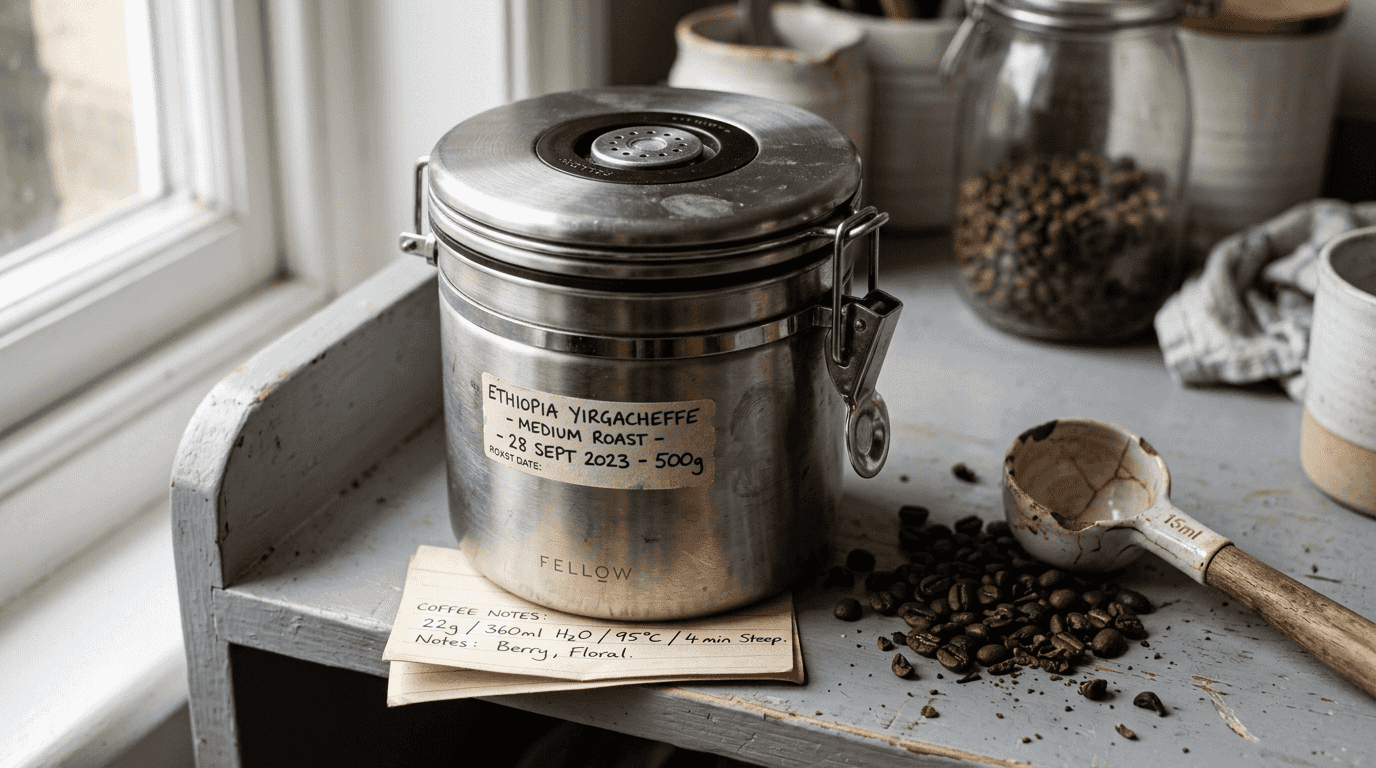
Your storage environment matters as much as your container choice. Identify a location that maintains consistent room temperature, ideally between 15°C and 21°C, away from heat-generating appliances. Avoid spots near ovens, kettles, or windows where temperature fluctuates throughout the day. A dedicated cupboard or pantry shelf provides the stable, dark environment coffee needs.
Pro tip: Label your containers with the roast date and variety. This simple habit helps you rotate stock and consume beans at their flavour peak, especially when you're exploring different coffee by the kilo options.
| Container Type | Light Protection | Air Seal Quality | Best Use Case |
|---|---|---|---|
| Ceramic with rubber seal | Excellent | Excellent | Whole beans, daily use |
| Stainless steel canister | Excellent | Very good | Whole beans, travel |
| Dark glass with clamp lid | Very good | Good | Whole beans, short term |
| Valve bag (original) | Good | Excellent | Ground coffee, unopened |
| Clear plastic container | Poor | Variable | Avoid for coffee storage |
Consider purchasing multiple smaller containers rather than one large one. This strategy lets you store your main supply separately whilst keeping a smaller amount accessible for daily use. Each time you open a container, you expose the contents to oxygen. By limiting the frequency of opening your primary storage, you preserve freshness longer. The recyclable containers used by quality roasters often work brilliantly as secondary storage after the initial seal is broken.
How to store coffee beans step by step
-
Time your purchase strategically. Order coffee that's been roasted within the past 72 hours when possible. Freshly roasted beans reach peak flavour between three days and two weeks after roasting, depending on the roast level. Planning your purchase around your consumption rate ensures you're always brewing at optimal freshness.
-
Transfer immediately after opening. The moment you break the seal on your coffee bag, transfer the entire contents to your prepared airtight container. Don't leave beans in an opened bag, even if you fold the top down. The original packaging loses its protective properties once opened, and every hour of exposure accelerates staling.
-
Minimise headspace in your container. Fill your storage container as completely as possible, leaving minimal air above the beans. If you've purchased a large quantity, consider dividing it between a primary storage container you rarely open and a smaller daily-use container you refill weekly.
-
Select your storage location carefully. Place your sealed container in a cool, dark cupboard away from heat sources. Avoid storing near your oven, hob, dishwasher, or any appliance that generates warmth. Never store coffee on countertops exposed to sunlight, even indirect light through windows.
-
Never refrigerate your coffee beans. Refrigerators create a moisture-rich environment that causes condensation on beans every time you remove the container. This moisture damage destroys flavour and introduces off-flavours. The temperature fluctuations from removing and returning containers accelerate degradation rather than preventing it.
-
Adjust consumption timing by roast level. Lighter roasts should be consumed within two weeks whilst dark roasts remain fresh longer if stored sealed. Light roasts contain more delicate, volatile aromatics that dissipate quickly. Dark roasts, with their more robust flavour compounds and lower moisture content, tolerate longer storage periods. Match your purchase quantities to these timelines.
-
Handle beans with clean, dry hands or tools. Moisture and oils from your hands transfer to beans and accelerate staling. Use a clean, dry scoop dedicated to coffee. Never use a wet spoon or measure that's been used for other ingredients.
Pro tip: Buy light roast coffee in smaller quantities for frequent rotation, whilst dark roast coffee can be purchased in larger amounts without sacrificing quality. This strategy optimises both freshness and convenience.
Freshness does not follow one universal clock: roast profile, packaging and home storage all affect the cup. Use the roast date, aroma and flavour together, and buy an amount that can be finished while it still tastes its best. The combination of proper containers, a stable environment and smart handling preserves the complex flavours you're paying for.
How to store ground coffee
Store ground coffee in an airtight, opaque container or its well-sealed original bag, in a cool, dark cupboard. Ground coffee has much more surface exposed to air than whole beans, so the aroma fades faster once it has been ground.
Buy ground coffee in smaller quantities and open only the amount needed for the next few brews. Keep the scoop clean and dry, close the container straight away, and avoid the fridge: moisture and odours are the risks to avoid, not just temperature.
- Choose an opaque container with a close-fitting lid.
- Keep it away from the cooker, kettle, dishwasher and window.
- Grind whole beans immediately before brewing whenever possible.
- For pre-ground coffee, use it promptly after opening rather than treating the container as long-term storage.
What is the 15-15-15 rule for coffee?
The 15-15-15 rule is a simple freshness reminder rather than a universal standard. The most common version is: use green coffee within 15 months of harvest, enjoy roasted coffee around 15 days after roasting, and brew ground coffee within 15 minutes of grinding.
Some guides use a different final 15 for drinking brewed coffee within 15 minutes, while others frame the rule as a target after opening. The useful principle is consistent: check the roast date, grind immediately before brewing and make only the coffee you plan to drink.
Common mistakes and troubleshooting coffee storage problems
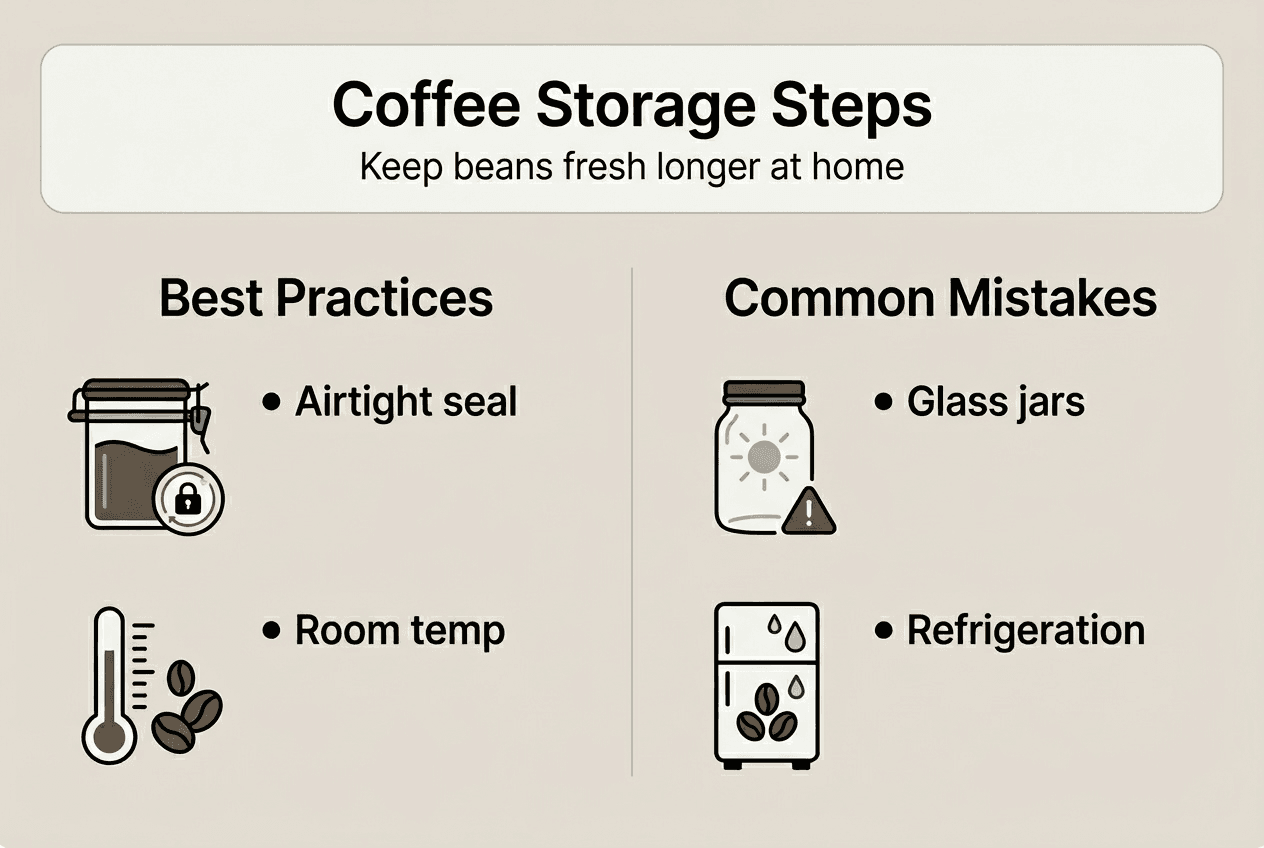
Transparent containers represent the most common storage error. Many coffee lovers choose attractive glass jars displayed on countertops, unknowingly exposing their beans to constant light damage. Even ambient kitchen lighting degrades flavour compounds over days. If you love the aesthetic of visible beans, reserve this display for a small amount you'll consume within 48 hours whilst properly storing your main supply.
Refrigeration remains persistently popular despite being actively harmful. The logic seems sound, cool temperatures should preserve freshness, but refrigerators cause moisture damage that far outweighs any temperature benefit. Every time you remove beans from the cold environment, condensation forms on their surface. This moisture penetrates the bean structure, diluting oils and creating flat, lifeless flavours.
Heat exposure often goes unnoticed because it's gradual. Storing coffee near your kettle, toaster, or oven subjects beans to temperature spikes throughout the day. High temperatures accelerate staling reactions, with each 10°C increase doubling the degradation rate. Relocate your storage to a genuinely cool spot, not just one that feels convenient.
Frequent container opening introduces oxygen repeatedly, particularly problematic with large containers. Each time you open your storage, you flush out the protective carbon dioxide layer that naturally forms above the beans and replace it with oxygen-rich air. This repeated exposure accumulates, significantly shortening freshness. The solution is simple: use a small daily container refilled from a larger sealed supply.
- Storing beans in original bags after opening provides inadequate protection
- Placing containers near windows exposes beans to temperature swings and UV light
- Using containers without proper seals allows constant air infiltration
- Grinding beans in advance multiplies surface area and accelerates staling exponentially
- Ignoring roast dates leads to consuming beans past their prime
| Storage Problem | Symptom | Solution |
|---|---|---|
| Light exposure | Faded aroma, weak flavour | Switch to opaque container, relocate to cupboard |
| Moisture damage | Oily surface, musty smell | Never refrigerate, ensure completely dry container |
| Heat degradation | Rapid flavour loss, bitter notes | Move away from appliances, find cooler location |
| Oxygen exposure | Flat taste, loss of complexity | Upgrade to airtight container, reduce opening frequency |
| Extended storage | Stale, cardboard-like flavour | Purchase smaller quantities, check roast dates |
Recognising early staling signs helps you adjust your approach before quality deteriorates completely. Fresh coffee produces a pronounced aroma when you open the container and grind beans. If this aroma is weak or absent, oxidation has progressed significantly. The brewed coffee will taste flat, lacking the brightness and complexity you expect. At this point, even perfect brewing techniques cannot recover the lost quality.
Troubleshooting requires honest assessment of your storage practices. Walk through each element: container quality, seal integrity, storage location, handling frequency, and purchase timing. Identify which factor is compromising your coffee and address it systematically. Most storage problems have straightforward solutions that immediately improve your results.
Discover premium coffee and storage solutions at Coffee Factory
You've learned how proper storage transforms your coffee experience, now it's time to put that knowledge into practice with exceptional beans worth protecting. Coffee Factory delivers freshly roasted coffee straight from our Devon roastery to your door, ensuring you start with the highest quality foundation. Our unique coffee varieties span light to dark roasts, single origins to carefully crafted blends, each roasted to order for maximum freshness.
Our packaging is designed specifically for optimal storage. Each bag features professional-grade materials that protect your beans during transit and provide excellent storage once opened. Explore our coffee storage bags for additional options that maintain the freshness standards you've learned to prioritise. For ultimate convenience, our coffee subscriptions deliver fresh beans on your schedule, ensuring you never run out whilst consuming coffee at its absolute peak. With free UK delivery on coffee orders over 1kg, maintaining a supply of perfectly fresh coffee has never been easier.
Frequently asked questions about storing coffee beans
Should I store coffee beans in the freezer for long term storage?
Freezing coffee beans is acceptable only for long term storage of unopened, vacuum-sealed bags you won't use for months. Once frozen, never remove and refreeze beans, as temperature cycling causes severe moisture damage. For regular consumption, proper room temperature storage in airtight containers always produces better results than freezing.
What type of container is best for storing coffee beans at home?
Opaque, airtight containers made from ceramic, stainless steel, or dark glass provide the best protection. The container must completely block light and create a secure seal against air infiltration. Avoid transparent containers regardless of material, as light exposure rapidly degrades flavour compounds even in relatively dim environments.
How long do coffee beans stay fresh after opening the bag?
Properly stored coffee beans do not have one fixed peak-freshness window. Roast profile, packaging and storage conditions all matter, so use the roast date alongside the aroma and flavour in the cup. The 15-15-15 rule is a useful benchmark: enjoy roasted coffee around 15 days after roasting and brew ground coffee within 15 minutes of grinding.
Why does my coffee taste flat even though I store it in an airtight container?
Flat-tasting coffee despite proper storage usually indicates beans that were already past their prime when purchased or exposure to heat near your storage location. Check the roast date and ensure your container isn't near heat-generating appliances. Coffee loses flavour naturally over time, so purchasing smaller quantities more frequently ensures consistent quality.
Can I store different coffee varieties in the same container?
Never mix different coffee varieties in one container, as their distinct flavours will blend and muddle, eliminating the unique characteristics you purchased each variety for. Additionally, different roast levels and origins have varying optimal consumption windows. Use separate containers for each variety to preserve their individual profiles.
How do I know when my stored coffee beans have gone stale?
Stale coffee beans produce weak aroma when you open the container and grind them. The brewed coffee tastes flat, lacks complexity, and may have cardboard-like or dull flavours. Fresh beans release a strong, pleasant aroma and produce vibrant, complex flavours in the cup. Trust your nose and palate, they're reliable indicators of freshness.
Recommended
- Buy Unique Coffee Varieties online at Coffee Factory | Fast Delivery
- Why We Chose Recyclable Over Compostable Hint: It's Better for the Bea
- Quick brew guide
- Buy 1kg Coffee | Premium coffee by the kilo | Fast UK delivery
- Organic Coffee Brands with UK Delivery: 2026 Review
- Specialty coffee trends 2026: UK enthusiasts guide