

What is sustainable coffee: a guide for UK enthusiasts
You've probably seen labels like Fairtrade, Rainforest Alliance, or Organic on coffee bags and wondered what they actually mean. Sustainable coffee isn't just about one certification or farming method. It's a complex balance of environmental practices, social fairness, and economic viability that spans the entire supply chain from farm to cup. Many coffee lovers struggle to distinguish genuine sustainability from marketing spin, especially as new terms like regenerative agriculture enter the conversation. This guide will clarify what sustainable coffee truly entails, decode the certifications, and show you how to make informed choices that support better coffee production whilst enjoying exceptional flavour.
Table of Contents
- Key takeaways
- What sustainable coffee really means
- Certifications and regenerative agriculture explained
- Balancing environmental impact and social fairness
- How to choose authentic sustainable coffee
- Explore sustainable coffee at Coffee Factory
- Frequently asked questions
Key Takeaways
| Point | Details |
|---|---|
| Pillars of sustainability | Sustainable coffee rests on environmental, social and economic pillars that guide production from farm to cup. |
| Certifications explained | Certifications such as Fairtrade and Rainforest Alliance provide third party verification, but each emphasises different sustainability aspects and can involve trade offs for farmers. |
| Regenerative agriculture | It aims to restore soil health and biodiversity, though definitions and metrics vary across schemes. |
| Direct trade impact | Direct trade models often bypass certifications, aiming for fairer pricing and greater transparency. |
| Consumer impact | Choosing sustainable coffee supports farmers, ecosystems, and better coffee quality. |
What sustainable coffee really means
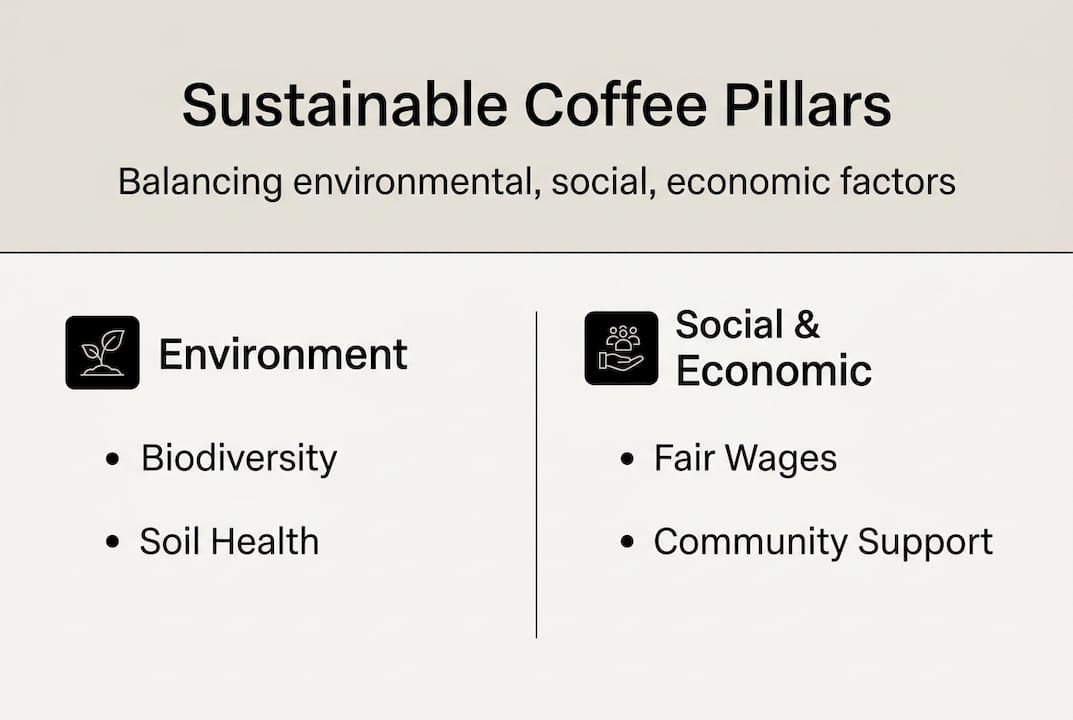
Sustainable coffee rests on three interconnected pillars that work together to create a responsible production system. The environmental pillar includes practices like shade-grown cultivation that preserves biodiversity, organic farming that eliminates synthetic pesticides, and water conservation methods that protect local ecosystems. The social pillar ensures fair wages for workers, prohibits child labour, and supports community development in coffee-growing regions. The economic pillar provides stable pricing that allows farmers to invest in their land and families whilst maintaining quality standards.
Sustainable coffee is defined by balancing environmental stewardship, social fairness, and economic viability, verified by certifications like Fairtrade, Rainforest Alliance and Organic. These coffee sustainability certifications serve as third-party verification that producers meet specific standards, though each programme emphasises different aspects of sustainability.
The scope of sustainable coffee extends far beyond the farm itself. It encompasses the entire supply chain, from how beans are harvested and processed to how they're transported, roasted, and packaged. This comprehensive approach recognises that sustainability isn't achieved through isolated actions but through systemic change across every stage of production.
Key certification programmes include:
- Fairtrade focuses on fair prices, democratic cooperatives, and community development premiums
- Rainforest Alliance prioritises biodiversity conservation, ecosystem protection, and improved farmer livelihoods
- Organic certification bans synthetic fertilisers and pesticides whilst promoting soil health
- UTZ (now merged with Rainforest Alliance) emphasised good agricultural practices and supply chain traceability
These sustainability practices represent different pathways to the same goal, though they measure success through distinct criteria. Understanding what each certification guarantees helps you align your purchases with your values.
"Fairtrade certification guarantees coffee farmers receive a minimum price of $1.80 per pound plus an additional premium for community investment, ensuring economic stability even when market prices fluctuate."
This safety net protects smallholder farmers from the volatile commodity market that has historically left them vulnerable to poverty despite producing a valuable crop.
Certifications and regenerative agriculture explained
Different certification schemes and emerging approaches like regenerative agriculture offer distinct pathways to sustainability, each with unique strengths and limitations. Understanding these differences helps you evaluate which methods align best with your priorities.
| Certification | Primary focus | Key requirements | Price premium |
|---|---|---|---|
| Fairtrade | Social and economic justice | Minimum price $1.80/lb, democratic cooperatives, community development fund | $0.20/lb premium |
| Rainforest Alliance | Environmental conservation | Biodiversity protection, reduced chemical use, worker welfare standards | Variable, typically $0.05-$0.15/lb |
| Organic | Environmental health | No synthetic inputs, soil conservation, certified processing | $0.30-$0.50/lb premium |
| Regenerative | Ecological restoration | Soil health improvement, carbon sequestration, biodiversity gains (outcome-based) | Emerging, often higher |
Certified standards include Fairtrade with minimum price and premium, Rainforest Alliance for biodiversity, Organic banning synthetic inputs, and emerging regenerative focusing on soil and biodiversity outcomes. Each certification requires annual audits and fees that can challenge smallholder farmers, though the premiums often offset these costs when market access improves.
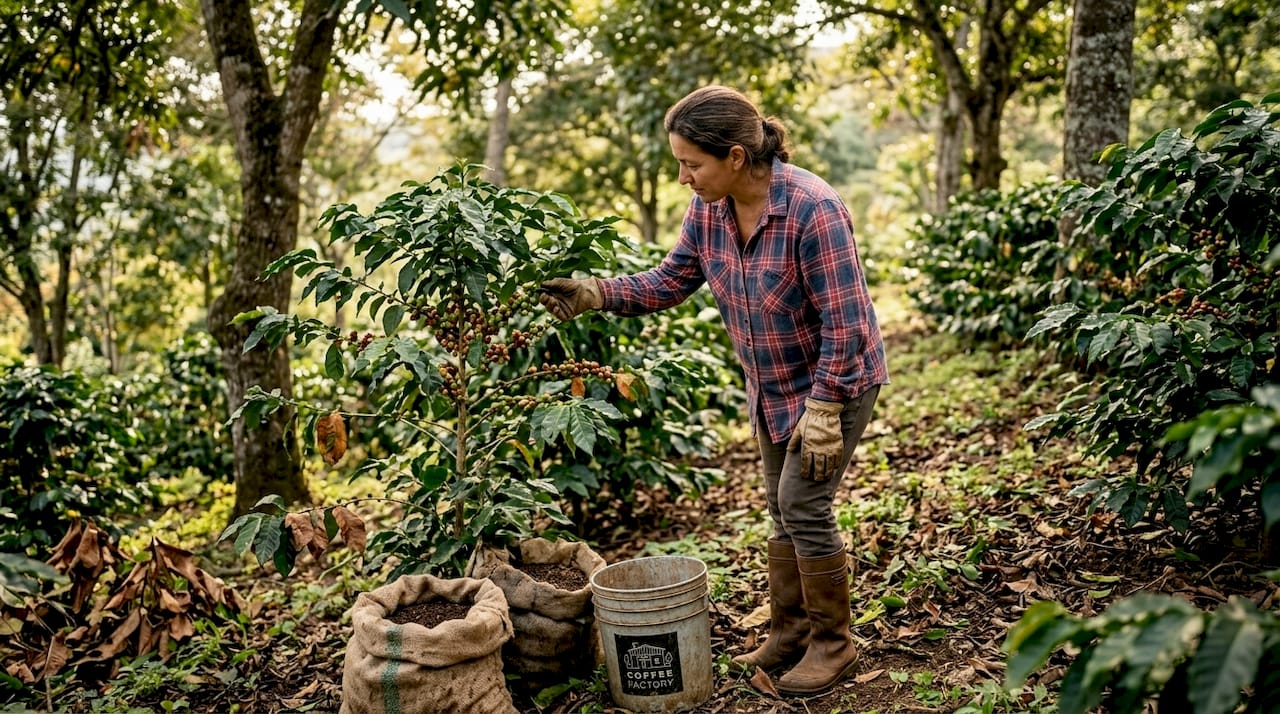
Fairtrade's pricing model provides the most direct financial benefit, guaranteeing farmers receive at least $1.80 per pound of green coffee plus a $0.20 premium designated for community projects like schools or clean water systems. This structure creates a safety net when global coffee prices crash, as they did in 2019 when the commodity market dropped below $1.00 per pound.
Regenerative coffee represents a paradigm shift from input-based standards to outcome-based metrics. Regenerative coffee programmes focus on soil restoration, agroforestry and carbon sequestration but lack a universal definition, emphasising measurable outcomes. Rather than prohibiting specific practices, regenerative approaches measure improvements in soil organic matter, biodiversity indicators, and carbon storage. Farms demonstrate success through baseline assessments and ongoing monitoring rather than compliance checklists.
This flexibility allows farmers to adapt practices to their specific ecosystems and resources, potentially making regenerative methods more accessible than certification programmes. However, the lack of standardised definitions creates opportunities for greenwashing, where companies make vague regenerative claims without substantive evidence.
Pro Tip: When evaluating regenerative coffee claims, look for specific metrics like soil organic carbon percentages, biodiversity counts, or third-party verification. Avoid products that use regenerative as a buzzword without providing measurable data or transparent sourcing information.
The limitations of certifications extend beyond cost barriers. Audit processes can be inconsistent, standards may not address all sustainability dimensions, and certification doesn't guarantee exceptional quality. Some specialty coffee sustainability programmes combine certifications with direct relationships and quality incentives to create more comprehensive models. The evaluation of coffee certifications requires understanding both their achievements and their gaps.
Balancing environmental impact and social fairness
The environmental and social dimensions of sustainable coffee often involve complex trade-offs that challenge simple narratives about what makes coffee truly sustainable. Understanding these nuances helps you make choices that align with your priorities whilst recognising the real-world constraints farmers face.
Empirical data shows median farm greenhouse gas emissions at 3.6 kg CO2eq per kg green coffee, with farm production accounting for 53% of roastery emissions. The carbon footprint varies significantly based on farming practices, processing methods, and transportation distances.
| Supply chain stage | Median emissions (kg CO2eq/kg green coffee) | Range | Key factors |
|---|---|---|---|
| Farm production | 3.6 | 1.2 to 8.4 | Fertiliser use, shade trees, processing method |
| Processing | 0.8 | 0.3 to 2.1 | Water use, drying method, energy source |
| Transport to port | 0.4 | 0.1 to 1.2 | Distance, transport mode |
| Shipping | 0.3 | 0.2 to 0.5 | Container efficiency, route |
| Roasting | 3.2 | 2.1 to 4.8 | Roaster efficiency, energy source |
These figures reveal that both farm practices and roasting contribute substantially to coffee's carbon footprint, suggesting that sustainability requires attention across the entire supply chain rather than focusing solely on farming methods.
Social fairness considerations extend beyond fair wages to encompass multiple dimensions of farmer and worker wellbeing:
- Fair compensation that covers production costs and provides living wages for farmers and workers
- Prohibition of child labour and forced labour throughout the supply chain
- Safe working conditions including protective equipment and reasonable hours
- Access to education and healthcare for farming communities
- Gender equity in ownership, decision making, and compensation
- Smallholder accessibility to markets, certifications, and technical support
Certification costs can exclude smallholders, with direct trade often paying better prices and avoiding certification barriers whilst regenerative agriculture outcomes are promising but sometimes contested. Annual certification fees can range from $1,500 to $5,000, representing a significant investment for smallholder farmers who may only earn $2,000 to $3,000 annually from coffee.
Direct trade models address this barrier by establishing long-term relationships between roasters and producers without requiring third-party certification. These partnerships often pay premiums exceeding certified prices whilst investing in farm improvements and community development. The transparency inherent in direct relationships can provide greater assurance of sustainable practices than certification alone.
The trade-offs become particularly stark when examining carbon-negative farming systems. Shade-grown coffee with extensive agroforestry can sequester more carbon than it emits, creating a net environmental benefit. However, these systems typically produce lower yields per hectare, potentially reducing farmer income unless premium prices compensate for reduced volume. Conscious coffee roasting practices can help offset emissions whilst supporting farmers who prioritise environmental stewardship.
"Coffee farms employing extensive shade cover and organic practices can achieve carbon-negative status, sequestering 2 to 4 tonnes of CO2 per hectare annually, though yields may be 30% lower than intensive sun-grown systems."
This tension between environmental performance and economic viability highlights why sustainable coffee requires holistic solutions rather than single-dimensional approaches. The most effective models balance ecological restoration with farmer prosperity, recognising that poverty undermines long-term sustainability regardless of farming methods.
Pro Tip: Support coffee supply chain sustainability by seeking roasters who maintain transparent relationships with producers and share detailed sourcing information. Transparency about pricing, farming practices, and community investment indicates genuine commitment beyond marketing claims.
Sustainable coffee in the UK market
The United Kingdom drinks an estimated 98 million cups of coffee per day, placing it among Europe's most significant coffee markets. Consumer expectations around sustainability have shifted substantially in recent years, with environmental and ethical considerations now influencing purchasing decisions across retail, foodservice, and wholesale channels alike.
The UK is one of Fairtrade's largest markets globally, with British consumers demonstrating consistent willingness to pay premiums for certified products. Major UK retailers including Waitrose, Marks and Spencer, and Sainsbury's have committed to sourcing significant proportions of their own-brand coffee from certified sustainable origins, reflecting mainstream demand rather than niche preference.
| UK sustainable coffee signal | What it indicates |
|---|---|
| Fairtrade logo on packaging | Minimum price guarantee, democratic cooperatives, community premium |
| Rainforest Alliance seal | Biodiversity and ecosystem standards, worker welfare criteria |
| Organic certification (Soil Association) | No synthetic inputs, UK-recognised Soil Association or EU Organic mark |
| Direct trade notation | Roaster sourced directly from producer — look for specific farm or co-op name |
| Regenerative claim | Requires supporting data — ask for soil or biodiversity metrics |
Independent UK roasters have led adoption of direct trade and regenerative sourcing models, often exceeding certification requirements without relying solely on packaging labels. This has created a two-tier market: commodity-grade sustainable coffee meeting minimum certification standards, and specialty-grade sustainable coffee emphasising traceability, quality premiums, and genuine producer relationships.
For UK shoppers, the practical implication is that certification is a useful baseline but not a ceiling. The Soil Association's organic mark is the most widely recognised UK organic certification for food products and provides credibility beyond the EU Organic designation. When buying from independent roasters, ask directly about sourcing rather than relying on labels alone — transparent roasters with strong producer relationships typically share detailed information without prompting.
Pro Tip: UK-based roasters attending events like the London Coffee Festival or the Speciality Coffee Association's UK events often represent the most transparent and sustainability-focused operations in the country. These connections can lead to discovering outstanding coffees before they reach wider retail distribution. Browse specialty coffee beans roasted in Devon with full transparency on sourcing and process.
How to choose authentic sustainable coffee
Navigating sustainability claims requires critical evaluation skills and knowledge of what indicators signal genuine commitment versus superficial marketing. You can identify truly sustainable coffee by following systematic verification steps and recognising common greenwashing tactics.
Steps to verify sustainable coffee:
- Check for recognised certifications like Fairtrade, Rainforest Alliance, or Organic, noting what each guarantees
- Research the producer or cooperative to understand their farming practices and community impact
- Ask roasters about their sourcing relationships, pricing models, and transparency commitments
- Look for specific data on regenerative practices such as soil health metrics or biodiversity assessments
- Verify traceability by checking if the roaster can identify the specific farm, cooperative, or region
- Evaluate the roaster's overall sustainability approach including packaging, energy use, and waste reduction
Consumers should verify regenerative claims, favour outcome-based metrics, and consider direct trade or certified products that meet comprehensive sustainability criteria. Genuine sustainability programmes provide transparent documentation rather than relying on vague marketing language.
Red flags that suggest greenwashing:
- Vague claims like "eco-friendly" or "ethical" without specific certifications or measurable practices
- Multiple sustainability buzzwords (regenerative, carbon-neutral, climate-positive) without supporting data
- Lack of traceability or unwillingness to identify specific producers or regions
- Sustainability claims that focus only on packaging whilst ignoring farming practices
- Absence of third-party verification for environmental or social claims
- Pricing that seems too low to support fair farmer compensation
Authentic sustainable coffee often costs more than conventional options because it reflects the true cost of responsible production. Whilst premium pricing alone doesn't guarantee sustainability, suspiciously cheap coffee claiming sustainability credentials warrants scepticism. Fair compensation for farmers, environmental stewardship, and quality processing all require investment that should be reflected in retail prices.
Prioritise producers and roasters who demonstrate transparency about their entire supply chain. The best sustainable coffee companies share detailed information about where beans come from, how much they pay farmers, what environmental practices are employed, and how they measure impact. This openness indicates accountability and genuine commitment rather than marketing opportunism.
Pro Tip: Support small batch roasters focused on traceability and direct relationships with producers. These roasters often maintain closer connections with farmers, provide better pricing, and can verify sustainability practices through firsthand knowledge rather than relying solely on certifications. Browse specialty coffee beans from roasters who prioritise these relationships.
Sustainable coffee typically delivers superior flavour alongside ethical production. The farming practices that benefit the environment and farmers also tend to produce better quality beans. Shade-grown coffee develops more complex flavours, organic practices enhance terroir expression, and fair compensation allows farmers to invest in careful harvesting and processing. When you choose sustainable coffee, you're not sacrificing quality for ethics but rather accessing the exceptional flavour that responsible production enables. Explore unique coffee varieties that showcase how sustainability and quality reinforce each other.
Explore sustainable coffee at Coffee Factory
Now that you understand what makes coffee truly sustainable, you can put that knowledge into practice by choosing ethically sourced beans that support both exceptional quality and responsible production. Coffee Factory curates a selection of sustainably produced coffees from our Devon roastery, prioritising transparency, quality, and environmental stewardship across our supply chain.
Our commitment to sustainability extends from the farms we partner with to the packaging we use, ensuring your coffee choice supports positive change throughout the industry. We work directly with producers who share our values, seeking out unique coffee varieties that showcase both exceptional flavour and responsible farming practices. Whether you prefer fresh ground coffee or whole beans, our range includes options that align with your sustainability priorities whilst delivering the quality you expect.
Explore our specialty coffee beans to discover coffees that reflect our dedication to craft, transparency, and conscious sourcing. Each selection represents our ongoing commitment to supporting better coffee production whilst bringing you outstanding flavour from farm to cup.
Frequently asked questions
What is the difference between Fairtrade and organic coffee?
Fairtrade certification focuses on social and economic fairness, guaranteeing minimum prices, fair wages, and community development premiums for coffee farmers and workers. Organic certification addresses environmental criteria by banning synthetic pesticides and fertilisers whilst promoting soil health and ecosystem protection. Whilst they address different sustainability pillars, many coffees carry both certifications, combining social justice with environmental stewardship. Learn more through our coffee certification guide.
How does regenerative coffee differ from traditional certifications?
Regenerative coffee measures success through ecological restoration outcomes like improved soil health, increased biodiversity, and carbon sequestration rather than prohibiting specific inputs as traditional certifications do. Definitions and standards are still emerging across the industry, with different programmes using varied metrics and verification methods. This outcome-based approach offers flexibility but requires careful scrutiny to avoid greenwashing. Discover more about emerging trends in regenerative coffee insight.
Can I trust sustainable claims without certifications?
Certifications provide valuable third-party verification but aren't the only indicator of genuine sustainability. Direct trade relationships and detailed traceability can offer transparency that equals or exceeds certification programmes, especially when roasters maintain long-term partnerships with producers and share comprehensive sourcing information. Look for credible roasters who provide specific details about farming practices, pricing, and producer relationships rather than relying on vague marketing claims. Explore traceable specialty coffee from roasters committed to transparency.
Does sustainable coffee actually taste better?
Sustainable farming practices often enhance coffee quality by allowing beans to develop more complex flavours through shade growing, careful harvesting, and meticulous processing. Fair compensation enables farmers to invest in quality improvements rather than maximising volume, whilst organic and regenerative practices enhance terroir expression. Whilst sustainability doesn't automatically guarantee exceptional taste, the conditions that support environmental and social responsibility typically also support superior flavour development.
How much more should I expect to pay for sustainable coffee?
Sustainable coffee typically costs 20% to 50% more than conventional options, reflecting the true cost of fair farmer compensation, environmental stewardship, and quality processing. Certified organic often commands the highest premiums, whilst Fairtrade and Rainforest Alliance certified coffees fall in the middle range. Direct trade pricing varies widely based on quality and relationship depth. This premium represents investment in better livelihoods, healthier ecosystems, and superior quality rather than unnecessary markup.