

Master the business coffee purchasing process for better brews
TL;DR:
- Poor workplace coffee impacts morale, increases café trips, and signals insufficient investment in staff needs.
- Proper assessment of actual consumption, equipment, and maintenance options ensures reliable quality and long-term satisfaction.
Poor coffee in the workplace is more than a minor inconvenience. It affects staff morale, increases the number of trips to nearby cafés, and quietly signals that the business does not invest in its people. Many UK businesses continue to settle for subpar coffee not because they lack the budget, but because the purchasing process feels unclear. This guide breaks down each stage of sourcing premium coffee for your workplace, from assessing your actual needs through to maintenance contracts and supplier selection, so you can make confident, well-informed decisions.
Table of Contents
- Understanding coffee needs and workplace requirements
- Choosing and sourcing the right coffee and equipment
- Maintenance, hygiene, and water quality essentials
- Maintenance contracts, response times, and support considerations
- The business coffee process: lessons they do not teach you
- Elevate your office coffee with expert sourcing
- Frequently asked questions
Key Takeaways
| Point | Details |
|---|---|
| Tailor setup to usage | Assess real consumption patterns and workflow rather than relying solely on staff numbers. |
| Choose flexible suppliers | Pilot programmes, recipe support, and onboarding reduce long-term risk when choosing beans and equipment. |
| Prioritise maintenance | Routine cleaning and scheduled maintenance contracts are vital for reliability and consistent taste. |
| Factor in water quality | Use proper filtration and descaling routines to prolong machine life and guarantee flavour. |
| View coffee as culture | Treat your workplace coffee as an ongoing culture investment, not just a one-off purchase. |
Understanding coffee needs and workplace requirements
Before ordering anything, it is worth stepping back to assess what your business genuinely requires from a coffee setup. Many purchasing decisions go wrong at this stage because they rely on headcount as the primary measure. In practice, bean volume and machine workflow drive total usage more than headcount. A team of 20 people working staggered shifts with only brief breaks may consume far less coffee than a team of 15 who gather in the kitchen frequently and serve drinks to visiting clients.
Mapping actual workflow patterns gives a much clearer picture. Consider tracking coffee consumption over a two-week period before committing to any new equipment or supply arrangement. This small investment of time prevents costly over-ordering or, more commonly, insufficient supply during peak periods.
Key factors to evaluate before purchasing:
- Average number of drinks prepared per hour during peak periods
- Drink types required (espresso, filter, bean-to-cup, instant alternatives)
- Staff preferences, including decaffeinated and milk-based options
- Delivery frequency and storage capacity on-site
- Whether the setup will also serve clients or visitors
Understanding these factors feeds directly into office coffee solutions that match your environment rather than solutions designed for a generic office.
Comparison of volume estimation approaches:
| Estimation method | Accuracy | Effort required | Risk |
|---|---|---|---|
| Headcount only | Low | Minimal | Over or under supply likely |
| Role-based averaging | Medium | Low | Moderate accuracy |
| Tracked daily consumption | High | Moderate | Most reliable baseline |
| Workflow-mapped usage | Very high | Higher initially | Best long-term fit |
Piloting a new setup before committing long-term is one of the most practical steps available. Many suppliers offer trial periods of four to eight weeks. Use this time to gather staff feedback on drink quality, machine speed, and ease of use.
Pro Tip: During any trial period, request recipe calibration and technical onboarding from the supplier. This ensures the machine is set up correctly from day one and that staff are not left guessing at settings. A poorly configured machine during a trial will give you an inaccurate picture of what the equipment can actually deliver.
Consulting a dedicated business coffee supply resource at this stage can also help clarify what types of agreements and delivery models are available to UK businesses.
Choosing and sourcing the right coffee and equipment
Once you have a clear picture of your needs, you can start evaluating options and securing reliable supply. Equipment selection is one of the most consequential decisions in the entire process, and it involves more than just comparing machine specifications.

Commercial coffee equipment selection commonly includes considering a service relationship such as purchase versus rental or lease, trial periods, and onboarding steps to reduce downtime risk. Each arrangement suits different business circumstances, and the differences in total cost and flexibility are significant.
Comparison of equipment acquisition models:
| Acquisition model | Upfront cost | Flexibility | Maintenance responsibility | Best suited for |
|---|---|---|---|---|
| Outright purchase | High | Low (you own it) | Business owner | Stable setups, long-term use |
| Rental | Low/none | High | Supplier | Growing or changing businesses |
| Lease | Medium | Medium | Shared or negotiated | Planned multi-year commitments |
Step-by-step equipment sourcing process:
- Define your volume requirements and drink types based on the assessment completed in the previous stage.
- Shortlist two or three machine types that match your output needs, ideally with input from a supplier or equipment specialist.
- Request demonstrations or trial units where possible before signing any agreement.
- Review the service agreement in detail, including response time commitments and what is covered in the event of a breakdown.
- Confirm onboarding support, including staff training on basic operation and daily cleaning routines.
- Establish a delivery schedule for your coffee supply that aligns with your storage capacity and usage rate.
- Set a review date at three months to assess whether the setup is meeting expectations and whether any adjustments are needed.
When reviewing coffee machines available for business use, it is worth comparing bean-to-cup models against traditional espresso machines and filter solutions. Bean-to-cup units tend to require less barista skill but need more consistent maintenance. Traditional machines offer greater control over quality but depend on trained staff for consistent results.
Sourcing coffee beans is a parallel process. The roast profile, origin, and freshness of the beans all affect the final cup. For businesses prioritising quality, working with a roastery that offers bulk coffee ordering with regular fresh dispatch cycles is far more reliable than purchasing pre-packaged supermarket blends. Freshness is a measurable factor. Coffee degrades noticeably within a few weeks of roasting if not stored correctly, and stale coffee is one of the most common reasons staff stop using office machines entirely.
Supplier credibility matters too. Look for roasteries and equipment providers with verifiable UK-based support, clear return policies, and transparent pricing structures. Ambiguous contracts or vague service commitments are a warning sign.
Maintenance, hygiene, and water quality essentials
With equipment and beans sorted, maintaining your investment is key for ongoing satisfaction and minimal disruptions. This is the area where most businesses underinvest, often until something goes wrong.
Routine cleaning, descaling, and milk-system cleaning materially affects reliability and taste. Maintenance schedules typically run daily wipe-down and clean, periodic deep cleans, and regular descaling with water filter attention. Skipping or inconsistently applying these routines accelerates component wear and introduces off-flavours into every cup.
Maintenance schedule by frequency:
- Daily: Wipe down exterior surfaces, clean group heads, purge steam wands, empty drip trays, rinse milk systems
- Weekly: Backflush with cleaning tablets, inspect and clean bean hoppers, check for blockages in the grinder
- Monthly: Full internal clean of milk circuits, inspect water filter status, check for scale build-up in visible components
- Every three to six months: Professional deep clean and descaling, replace water filters, inspect seals and gaskets
Neglected machines are among the top causes of preventable downtime in UK office environments. A single machine failure during a busy week can mean dozens of staff leaving the building for coffee, costing far more in lost time than a regular servicing contract would have.
Water quality is a purchasing-adjacent consideration that many businesses overlook entirely. Water hardness and filtration directly affects scale formation and descaling frequency. Hard water areas, which cover much of England, will accelerate limescale build-up inside boilers and pipes. Without proper filtration, a machine in a hard water area may require descaling three times as often as the same machine in a softer water region.
Installing an inline water filter appropriate for your local water hardness level is a practical and cost-effective measure. Filters typically need replacing every three to six months, depending on usage volume and local water conditions. Keeping a log of filter replacement dates makes it easier to stay on schedule and helps avoid warranty issues caused by scale damage.
Pro Tip: When setting up a new machine, have your local water tested for hardness before deciding on a filtration approach. Most filter suppliers provide free test strips. This one step can prevent significant maintenance costs over the life of the machine.
Referring to a detailed coffee equipment checklist can help businesses build a practical, site-specific maintenance routine that staff will actually follow.
Maintenance contracts, response times, and support considerations
Even with good day-to-day management, a solid support plan is your safety net against inevitable hiccups. Equipment will fail at some point. The question is not whether, but when, and how quickly someone will respond.
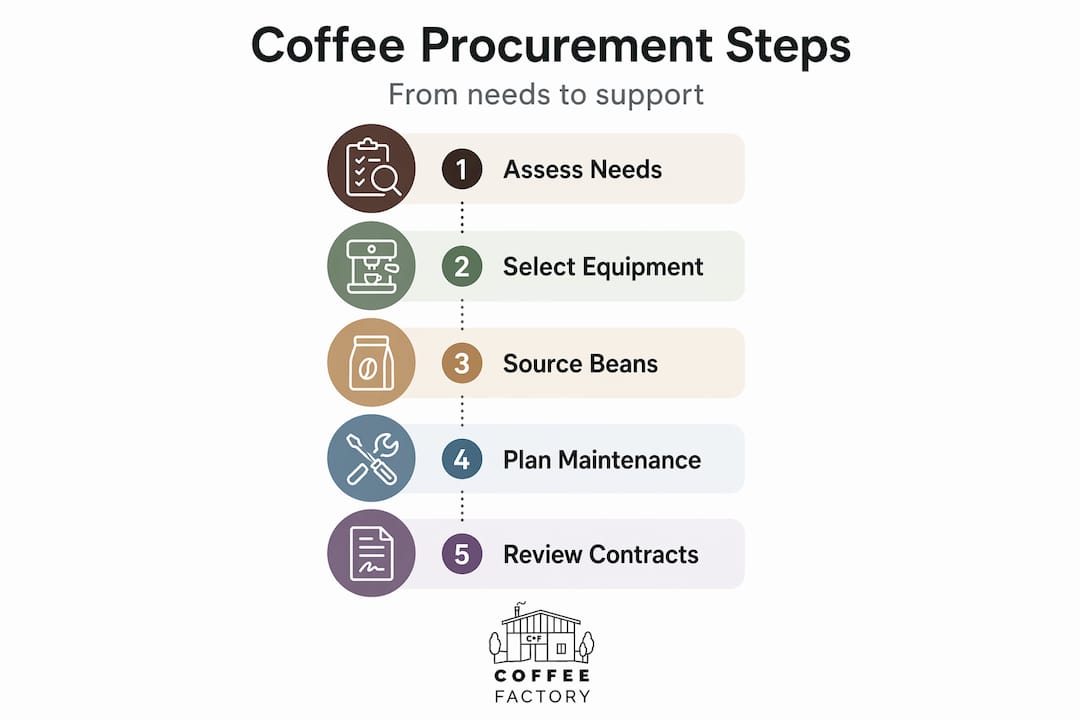
Maintenance contracts and response-time or service-level options are often treated as part of the purchasing process to prevent productivity disruption when the machine fails. Businesses that leave this until after installation typically face longer wait times and higher call-out fees.
Questions to ask any supplier or service provider before signing:
- What is the guaranteed response time for a breakdown call-out?
- Is there a difference in response time between working hours and out-of-hours calls?
- What parts and labour costs are included in the contract?
- How are replacement units handled during extended repair periods?
- Is there a limit on the number of call-outs included per year?
- What is the process for escalating unresolved issues?
- Are software or firmware updates included for bean-to-cup machines with digital interfaces?
Businesses that negotiate clear service-level agreements before installation consistently report fewer productivity disruptions. Response times of four hours or less for critical failures are a reasonable benchmark for a busy office environment.
Proactive maintenance scheduling is another consideration. Some suppliers offer planned visit programmes where a technician checks the machine on a set schedule, catching minor issues before they become failures. This approach often reduces total downtime more effectively than reactive repair contracts.
Investing time in barista training tips for the staff members responsible for daily machine operation is also worthwhile. Properly trained staff are far less likely to misuse equipment in ways that accelerate wear or trigger avoidable faults. The coffee benefits for office professionals extend well beyond the cup itself when the setup is managed correctly.
The business coffee process: lessons they do not teach you
Most procurement guides focus on the transactional elements: what to buy, how much to spend, which contracts to sign. What they rarely address is the organisational side of setting up coffee well in a workplace environment.
Focusing solely on price or headcount when making decisions leads to dissatisfaction reliably and repeatedly. A low-cost machine that cannot handle peak demand does not save money. It frustrates staff and generates hidden costs through lost productivity and increased servicing needs. Price is one input, not a decision driver.
Involving staff early in the pilot stage changes the outcome significantly. When people have a say in which blends are trialled or which drink types are prioritised, they are far more likely to use the setup consistently. This sounds straightforward, but many businesses treat coffee procurement as a facilities decision made entirely behind closed doors.
Unexpected factors cause the most problems in practice. Machine placement affects airflow and cooling. Water pressure variations across different parts of a building affect extraction consistency. The frequency of cleaning depends as much on staff habits as on usage volume. None of these appear in a standard buying guide, but all of them affect whether the investment delivers value.
Reviewing a coffee and productivity strategy for your business is worth doing before finalising any procurement plan. The connection between consistent coffee quality and workplace wellbeing is well documented, and the purchasing decisions that support it deserve the same level of planning as any other operational investment.
Pro Tip: Treat coffee provision as an evolving workplace culture project rather than a one-time commodity purchase. Set quarterly review points to assess quality, staff satisfaction, and machine performance. Small adjustments made regularly produce far better outcomes than a wholesale change every few years driven by frustration.
Elevate your office coffee with expert sourcing
Getting your workplace coffee right is a process, not a single purchase. The steps covered here, from volume assessment through to maintenance contracts and supplier selection, give your business the tools to make confident decisions and maintain consistent quality over time.
The Coffee Factory roasts fresh in Devon and delivers directly to businesses across the UK, with no middlemen and no compromises on freshness. Explore a full range of premium coffee beans suited to office environments, including single-origin options and reliable house blends. For consistent supply without the admin burden, coffee subscriptions are available with flexible delivery schedules to suit your usage patterns. Free shipping on coffee orders over 1kg applies across the range.
Frequently asked questions
What is the biggest mistake businesses make when buying coffee equipment?
Overlooking ongoing service and maintenance plans is a common mistake that leads to increased downtime and unexpected costs. Maintenance contracts and response-time options should be agreed before installation, not after the first breakdown.
How should I estimate coffee volume for my workplace?
Focus on tracking daily usage and workflow patterns rather than just the total headcount to ensure sufficient supply without waste. Bean volume and machine workflow are more reliable indicators of actual consumption than staff numbers alone.
How often should office coffee machines be cleaned?
Most machines require daily cleaning of key components and regular descaling according to the manufacturer's guidelines. Routine cleaning and descaling directly affects both drink quality and machine reliability over time.
Is water quality important in business coffee setups?
Yes, poor water quality accelerates scale build-up and increases machine maintenance needs, so filtration should always be considered. Water hardness and filtration is a key factor in determining how frequently descaling and filter replacement will be required.
How the parts of business coffee supply fit together
Business coffee supply is more than a regular bean order. It is a chain that runs from the farm, through roasting, to the equipment on your counter and the service that keeps it running. Each link affects the others. Excellent beans will taste dull through a poorly maintained grinder, and the best machine cannot rescue stale or low grade coffee. Thinking about the whole chain helps you avoid spending heavily on one part while another holds the quality back.
Taste before you commit
Before agreeing to a large or regular order, ask suppliers for samples and taste them side by side, ideally on the equipment you will actually use. This shows how each coffee behaves on your machine and gives you a quality baseline to measure future deliveries against.
Questions to ask about sourcing
- Can the roaster tell you where each coffee comes from, how it was processed and when it was harvested?
- How does the roaster check quality, and will it reject lots that fall short?
- Is there a long term relationship with growers, or is coffee bought on the open market each time?
- How soon after roasting is coffee dispatched to you?
Traceable coffee also gives you a story to tell customers and staff, which matters to a growing number of people who want to know where their coffee comes from. Certification schemes can guarantee growers a minimum price, but on their own they do not guarantee cup quality.
Matching machine type to your team
- Manual and semi-automatic espresso machines: give the most control and the best results in skilled hands, but depend on trained staff.
- Fully automatic machines: deliver consistent drinks with less skill required, and usually need manufacturer servicing.
- Bean-to-cup machines: need minimal skill from users but frequent cleaning cycles to stay reliable.
Whatever you choose, budget for a good burr grinder where one is needed and for water filtration in hard water areas.
Making your coffee supply more sustainable
Sustainability is increasingly part of how businesses choose suppliers. Practical steps include:
- Composting spent coffee grounds or passing them on for garden use rather than sending them to landfill.
- Choosing recyclable or compostable packaging where your supplier offers it.
- Selecting equipment designed to be repaired with replacement parts rather than thrown away.
- Choosing energy efficient machines, which cut running costs as well as emissions.
- Ordering to match real usage, so less coffee goes stale and gets wasted.
Long term relationships between roasters and growers also help, as steady demand gives farms the confidence to invest in quality and better growing practices.