

Step by step seasonal coffee selection for UK home brewers
TL;DR:
- Choosing seasonal coffee enhances flavour quality and aligns beans with the year’s natural harvest cycles.
- Freshness, origin, roast level, and storage are key factors influencing seasonal coffee selection and enjoyment.
- Switching coffees with the seasons boosts the daily ritual, prevents boredom, and improves taste appreciation.
Choosing coffee for home brewing should be straightforward, yet many UK coffee lovers find themselves reaching for the same bag out of habit, only to feel something is off. The cup tastes flat in January when you want warmth and body, or heavy and overpowering in June when something brighter would be far more satisfying. Seasonal coffee selection solves this problem. It matches bean origin, roast level, and freshness to the mood and temperature of each time of year. This guide walks through each step, so you can choose with confidence whatever the season.
Table of Contents
- Understanding seasonal coffee: why it matters
- What you need for the perfect seasonal selection
- Step by step: selecting coffee for each UK season
- Common pitfalls and troubleshooting your seasonal selection
- Fresh perspective: why seasonal selection transforms your coffee ritual
- Enhance your seasonal selection with Coffee Factory
- Frequently asked questions
Key Takeaways
| Point | Details |
|---|---|
| Seasonal selection boosts flavour | Choosing coffee based on the season enhances freshness and taste for every cup. |
| Spring to winter coffee guidance | Tailor your coffee choice to UK seasons for the best aromatic and palate experience. |
| Storage preserves seasonal quality | Proper storage keeps coffee beans fresh and preserves their unique seasonal qualities. |
| Avoid common mistakes | Follow best practices to dodge stale beans, mismatched roasts, and disappointing cups. |
| Discover new rituals | Seasonal coffee selection transforms the daily brew into a rewarding personal ritual. |
Understanding seasonal coffee: why it matters
Coffee is an agricultural product. Like fruit and vegetables, it follows global harvest cycles, and those cycles affect what arrives in UK roasteries throughout the year. When you buy beans that have been recently harvested and freshly roasted, the flavour is noticeably better. Brightness, sweetness, and clarity all improve compared to beans that have been sitting in a warehouse for months.
73% of coffee drinkers prefer freshly roasted beans over pre-ground or supermarket alternatives, and that preference comes down to one thing: flavour. Freshness is the single biggest lever you can pull to improve your home brew, and seasonal selection is how you access it consistently.
UK supply cycles are worth understanding. Broadly speaking, Central and South American harvests reach British roasters between January and June. East African coffees, from Ethiopia and Kenya, tend to arrive between October and March. Asian and Pacific origins, such as Sumatra, follow a different pattern entirely. Knowing this helps you predict what is fresh and available at any given time of year.
Key factors that affect seasonal suitability:
- Origin and harvest timing
- Roast date and days since roasting
- Roast level relative to the brewing method
- Storage conditions post-purchase
- Flavour profile and how it matches the season’s mood
| Origin region | Peak UK availability | Typical flavour notes |
|---|---|---|
| Central America | January to June | Chocolate, caramel, nuts |
| East Africa | October to March | Bright, floral, berry |
| South America | February to July | Balanced, sweet, mild acidity |
| Asia Pacific | Year round, peaks in autumn | Earthy, full-bodied, low acidity |
Pro Tip: Proper storage is just as important as buying fresh. Learn about storing beans for freshness to protect the work you put into selecting the right seasonal coffee.
What you need for the perfect seasonal selection
Before working through the seasonal steps, it helps to be clear on the tools and knowledge you need at home. Seasonal selection is not complicated, but a few basics make the difference between a good result and a great one.
The first decision is whether to choose single origin or blended coffee. This choice shapes everything else, and single origin coffee transforms espresso flavour in ways that blends rarely can. Single origin beans come from one farm, cooperative, or region, which means the flavour reflects the soil, altitude, and processing method of that specific place. Blends, by contrast, combine multiple origins to achieve a balanced and repeatable flavour across the year.
| Factor | Single origin | Blended coffee |
|---|---|---|
| Flavour intensity | High, location specific | Balanced, consistent |
| Seasonal variation | Changes with harvest | Minimised by blending |
| Best for | Filter, pour over, aeropress | Espresso, milk-based drinks |
| Freshness window | Short, narrow | Longer, more forgiving |
| Ideal drinker | Curious, experimental | Reliable daily drinkers |
Equipment and preparation checklist:
- A burr grinder (not blade) for consistent grind size
- An airtight, opaque storage container
- Scales to measure dose accurately
- A thermometer if using pour over or French press
- Access to the bean’s roast date and country of origin
Checking the roast date is non-negotiable. Beans need a short degassing period after roasting, usually two to seven days for filter and seven to fourteen days for espresso. After that, the ideal window is roughly two to four weeks. Anything beyond six weeks starts to lose character. When browsing single origin beans or exploring unique coffee varieties, always look for the roast date on the packaging before buying.
Step by step: selecting coffee for each UK season
The guide below works through all four seasons, with specific recommendations for roast level, origin, and brewing approach. Use the tables and checklists as quick references when shopping.
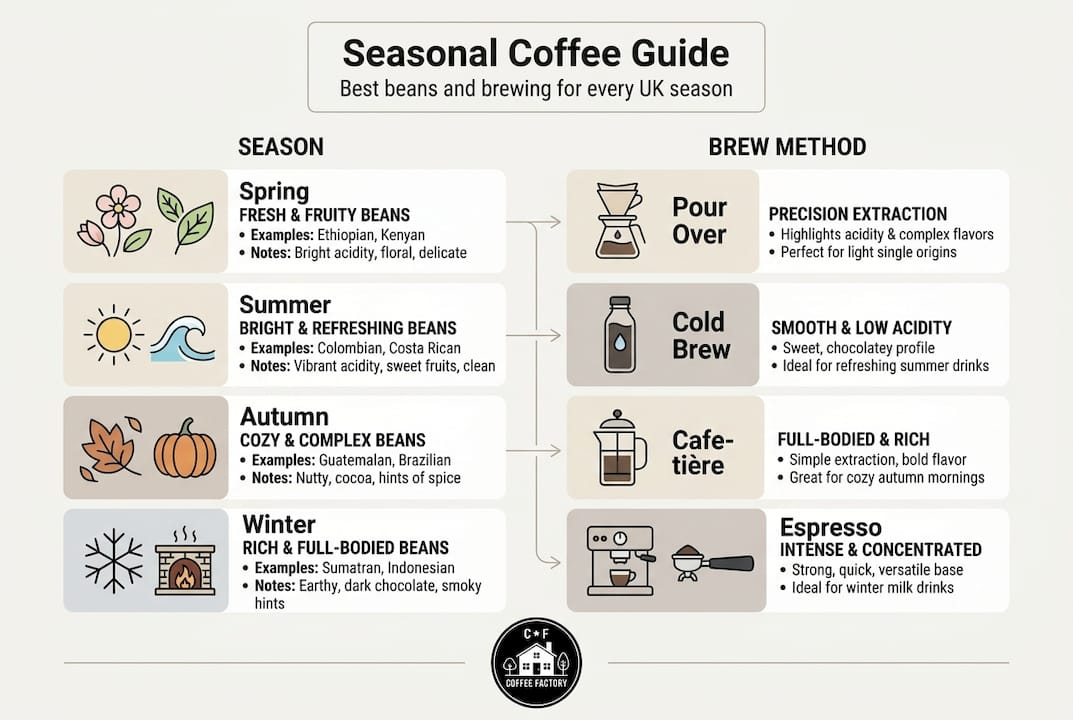
1. Spring (March to May)
Spring is a reset. After months of dark, heavy cups, the palate often craves something lighter and more lively. This is the ideal time to reach for East African origins, particularly Ethiopian naturals or washed Kenyans. Expect floral top notes, stone fruit sweetness, and a clean, bright finish.

Roast level: Light to medium light. Avoid anything labelled dark roast in spring, as the smokiness can feel heavy.
Brew method: Pour over, aeropress, or a simple filter machine. These methods highlight clarity and floral notes rather than masking them.
2. Summer (June to August)
Summer calls for refreshing coffee. Cold brew and iced pour over become genuinely useful methods rather than novelties. Colombian or Guatemalan beans harvested earlier in the year work well here, bringing notes of citrus, tropical fruit, and mild sweetness that hold up over ice without turning bitter.
Roast level: Light to medium. Avoid over-extracted espresso in the heat; it tends to feel sharp and unpleasant.
Cold brew ratio: 1:8 (coffee to water), steeped overnight in the fridge. Coarse grind recommended.
3. Autumn (September to November)
Autumn shifts the mood. The flavours shift too. This is when medium to medium-dark roasts start to feel appropriate again, particularly coffees with notes of hazelnut, baked apple, toffee, or gentle spice. Central American and some Indonesian origins work well here.
Roast level: Medium to medium-dark. Look for words like “chocolate,” “nutty,” and “caramel” on the label.
Brew method: Cafetière, stovetop moka pot, or a flat-bottomed filter. These methods bring more body and richness to the cup.
4. Winter (December to February)
Winter is the season for full-bodied, bold, comforting coffee. East African coffees are arriving fresh again from the new harvest, but so are many aged or natural-processed Indonesian beans. Dark roasts with notes of dark chocolate, treacle, and dried fruit make sense here.
Roast level: Medium-dark to dark. Espresso-based drinks come into their own in winter, especially with oat or whole milk.
Brew method: Espresso, cafetière, or moka pot. Rich, concentrated, warming.
| Season | Recommended origin | Roast level | Flavour notes | Best brew method |
|---|---|---|---|---|
| Spring | Ethiopia, Kenya | Light | Floral, berry, citrus | Pour over, aeropress |
| Summer | Colombia, Guatemala | Light-medium | Tropical, citrus, sweet | Cold brew, iced filter |
| Autumn | Central America, Indonesia | Medium | Hazelnut, toffee, spice | Cafetière, moka pot |
| Winter | Ethiopia, Sumatra | Medium-dark | Dark chocolate, dried fruit | Espresso, cafetière |
Check bean origins and flavours for more detail on how geography shapes taste. The relationship between altitude, processing method, and flavour is more significant than most people realise.
Pro Tip: For late evening winter gatherings, try a seasonal decaf that uses clean, natural processing. You get the same rich flavour without the caffeine keeping everyone awake until 2am. Options from our seasonal range use chemical-free decaffeination methods, so the taste is not compromised.
Good keeping coffee fresh practice applies to every season. Buy enough for two weeks at a time, no more. Explore the full specialty coffee range to find what fits each seasonal moment best.
Also, choosing coffee beans properly requires knowing what questions to ask. Roast date, origin, and processing method are the three most important pieces of information on any coffee label.
Common pitfalls and troubleshooting your seasonal selection
Even with a clear seasonal guide, things can go wrong. These are the most common mistakes and how to fix them.
Buying too much coffee at once
This is the most frequent error. A large bag feels like good value, but coffee stales quickly after the bag is opened. Oxygen is the main enemy. Once opened, ground coffee loses most of its character within a few days. Whole beans last longer but still decline noticeably after three to four weeks. Buy less, more often. Two to three weeks’ worth is the practical maximum.
Mismatching roast level with brewing method
A dark roast in a pour over will taste harsh and ashy. A light roast in a French press can taste thin and underwhelming. The method and roast need to align.
Using the wrong grind size
Grind size affects extraction, and stale beans extract differently from fresh ones. Fresh beans often need a slightly coarser grind because they release CO2 rapidly, which speeds up extraction. As beans age, they may need a finer grind to extract the same flavour. Adjust accordingly and track results.
Common pitfall checklist:
- Buying pre-ground coffee for seasonal use (flavour fades within days)
- Storing beans in the original bag without resealing
- Ignoring the roast date and buying on price alone
- Using boiling water directly on light roasts (85-92°C is more appropriate)
- Keeping beans near heat sources like ovens or direct sunlight
“The freshest seasonal coffee, stored poorly, tastes worse than adequately fresh coffee stored well. Storage is the underrated half of the equation.”
Coffee bean freshness tips are available in detail if you want to go further on storage method comparisons, including whether freezing beans is ever a good idea (the answer depends on quantity and use frequency).
Pro Tip: Follow local UK roasters and sign up for their newsletters or social channels. Many post alerts when new seasonal lots land. Getting on that list means you can act quickly when a limited harvest coffee becomes available, rather than discovering it when it has sold out.
Fresh perspective: why seasonal selection transforms your coffee ritual
There is a common assumption that coffee is coffee. Buy a bag, grind it, brew it. The result is more or less the same regardless of what month it is or where the beans came from. That assumption is understandable, but it is also the reason many home brewers feel stuck at a plateau.
Seasonal selection is not just about better flavour, though that benefit is real and measurable. It is about giving yourself a reason to re-engage with something you do every single day. When you choose a spring Ethiopian for its floral brightness, or deliberately reach for a winter Sumatran for its earthy warmth, the daily brewing routine becomes a small but deliberate act of choice. That matters.
There is also a learning dimension that casual coffee drinking rarely unlocks. Selecting by season requires you to notice flavour. What does a berry-forward natural process actually taste like versus a washed coffee from the same region? How does the same Colombian bean behave differently in a cold brew versus a pour over? These are questions you only start asking when you are making intentional choices, and answering them is genuinely satisfying.
The process of transforming espresso flavour with single origin beans is a practical example of this. Many home baristas assume espresso must be made with a blend. In reality, a well-chosen single origin at the right roast level can produce espresso that is more interesting and more personal than any commercial blend.
Seasonal selection also reduces fatigue. Drinking the same coffee every day for months leads to palate boredom. Switching coffees with the seasons keeps things fresh, gives you something new to notice, and makes the ritual feel worth maintaining. That is not a trivial outcome for something as daily as coffee.
Enhance your seasonal selection with Coffee Factory
The guide above gives a clear framework for choosing coffee that suits each season. The next step is finding fresh, high-quality seasonal coffees that are roasted to order and delivered quickly across the UK.
At The Coffee Factory, seasonal and single origin coffees are roasted in Devon and dispatched fresh. Browse seasonal coffee gifts if you want to share something well-chosen with friends or family. For ongoing access to the best seasonal lots without the effort of constantly checking availability, a coffee subscription delivers freshly roasted beans to your door at whatever frequency suits your household. Need guidance on getting the most from each seasonal purchase? The home brewing guide covers methods, ratios, and troubleshooting in practical detail. Free UK delivery is available on orders over £20.
Frequently asked questions
How can I tell if coffee is in season in the UK?
Check the roast date, origin, and product descriptions that highlight harvest timing. UK roasters update their ranges regularly when new seasonal lots arrive, and fresh roasted guidance explains what to look for on the label.
What is the difference between single origin and blended coffee for seasonal selection?
Single origin coffees reflect the unique character of one specific harvest and region, making seasonal variation more pronounced, while blends combine multiple origins to deliver a consistent flavour profile across the year. More detail on this is covered in the espresso flavour guide.
Does the roast level affect which coffee I should select for different seasons?
Yes. Lighter roasts suit spring and summer cups where brightness and clarity are desirable, while medium-dark and dark roasts deliver the richness and body that autumn and winter call for. How to choose coffee beans includes roast level guidance alongside origin information.
How do I keep my seasonal coffee fresh at home?
Store whole beans in an airtight, opaque container away from heat, light, and moisture. Buy in small quantities, roughly a two-week supply at a time, to maintain peak flavour from roast to cup. Full storage method comparisons are covered in optimal freshness in 2026.