

How coffee origin shapes the taste in your cup
TL;DR:
- Coffee origin significantly influences flavour, with its effects measurable scientifically through chemical fingerprints. Variations in processing, roast level, and farm micro-lot specifics can amplify or mask these origin-driven flavours, complicating the traditional regional palate map. Understanding these factors enhances informed coffee selection, emphasizing farm, processing, and roast details over just country labels.
Two bags of coffee sit side by side. Same roast level, same brew method, same grind size. Yet one tastes of bright red berries with floral top notes, while the other delivers dark chocolate and a heavy, almost syrupy body. The roaster did nothing different. The barista followed the same recipe. The only variable is where the coffee was grown. For many enthusiasts, origin remains an afterthought behind equipment choices or roast preferences. Scientific evidence, however, consistently points to origin as one of the primary drivers of what ends up in your cup.
Table of Contents
- What does ‘origin’ mean in coffee?
- How origin shapes coffee flavours: the science
- Origin versus processing: where does the flavour come from?
- Navigating origin as a coffee enthusiast: practical tips
- Why the conventional wisdom around coffee origin is changing
- Explore origin-driven coffees at Coffee Factory
- Frequently asked questions
Key Takeaways
| Point | Details |
|---|---|
| Origin drives flavour | Where coffee is grown largely determines its taste profile, more than most enthusiasts realise. |
| Altitude means intensity | High-altitude coffees are richer and more vibrant due to increased phenolics and volatiles. |
| Processing blurs boundaries | Experimental methods and darker roasting can overshadow origin, making flavours blend. |
| Seek single origin clarity | Choosing single origin and microlot coffees delivers the purest flavour expression. |
| Rethink old rules | The conventional wisdom about origin is changing—look beyond country labels for real terroir. |
What does ‘origin’ mean in coffee?
Origin is not simply the country name printed on a bag. It operates at several levels, and each level adds a layer of precision to your understanding of flavour. At the broadest scale, origin refers to the producing country: Ethiopia, Colombia, Guatemala, Indonesia. Narrow it further and you reach the region: Yirgacheffe, Huila, Antigua, Sumatra. Go deeper still and you arrive at the individual farm or estate. At the most specific level sits the micro-lot, a distinct section of a single farm, sometimes harvested from a single plot or even a single picking day.
Understanding origin coffee beans explained at this granular level matters because flavour compounds shift significantly even within the same country. The term terroir, borrowed from the world of wine, captures this well. Terroir describes the combined influence of soil chemistry, altitude, rainfall patterns, temperature variation, and the microorganisms present in a given growing environment. Each of these factors shapes the bean’s internal chemistry before it ever reaches a roaster.
Coffee origins decoded reveals how dramatically these variables play out in the cup. Here are typical flavour profiles associated with major producing regions:
- Ethiopia: Jasmine, bergamot, blueberry, stone fruit, light body
- Colombia: Red apple, caramel, milk chocolate, medium acidity
- Guatemala: Brown sugar, almond, dark chocolate, full body
- Kenya: Blackcurrant, tomato, bright citric acidity, juicy mouthfeel
- Brazil: Nutty, low acidity, peanut brittle, heavy body
- Yemen: Dried fruit, tobacco, wine-like complexity, earthy base
Scientific studies confirm that origin influences volatile compounds, chlorogenic acids, and caffeine content at a statistically significant level. A support vector machine (SVM) artificial intelligence model achieved 91% accuracy when classifying coffee origins solely from volatile compound signatures, confirming that origin leaves a measurable chemical fingerprint in every bean.
Now that you know coffee origin is more than a country name, let’s look at the scientific basis for how it changes flavour.
How origin shapes coffee flavours: the science
Coffee flavour is ultimately chemistry. The sensory experience in your cup depends on hundreds of volatile aromatic compounds, organic acids, and non-volatile compounds such as chlorogenic acids (CGAs). CGAs are plant-based antioxidants that contribute to bitterness and perceived acidity. Caffeine content varies by origin too, and it plays a role in both bitterness and mouthfeel.
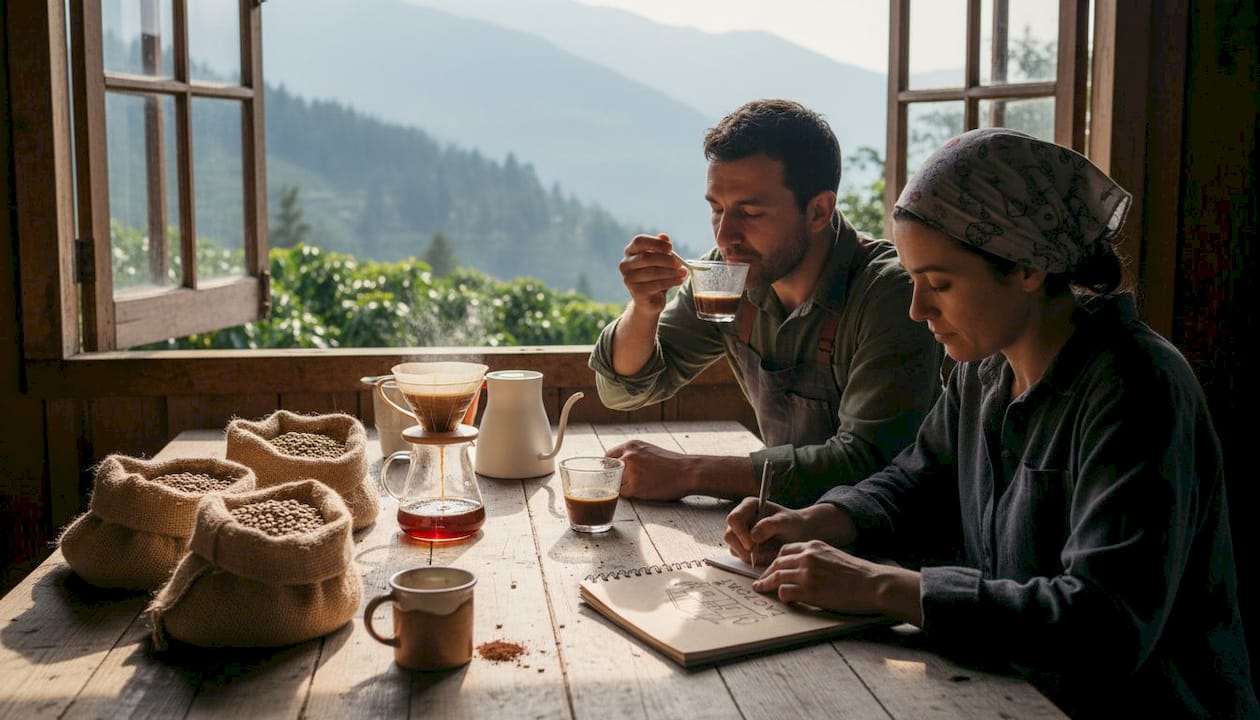
Altitude is one of the most reliable predictors of flavour complexity. Beans grown at higher elevations develop more slowly due to cooler temperatures and lower oxygen levels. This extended maturation period allows the cherry to accumulate greater concentrations of sugars, phenolic compounds, and volatiles. The relationship between altitude and flavour intensity is not anecdotal. Scientific studies confirm this link, with altitude showing a strong positive correlation with phenolic and volatile compound concentration.
| Altitude range | Typical cup characteristics | Complexity level |
|---|---|---|
| Below 900m | Mild, low acidity, flat profile | Low |
| 900m to 1,200m | Balanced, moderate acidity, light sweetness | Medium |
| 1,200m to 1,500m | Bright acidity, fruity notes, clean finish | High |
| Above 1,500m | Complex, layered volatiles, floral and fruit forward | Very high |
For single origin espresso flavours, the difference between a high-altitude Ethiopian lot and a low-altitude Brazilian bean becomes magnified under the pressure of espresso extraction. The concentrated format makes origin character easier to identify, though also easier to misinterpret without context.
A coffee profile guide from specialty roasters confirms that farm-level and micro-lot specificity often produces more consistent and distinctive flavour results than broad regional labelling. When a roaster lists a specific farm name and altitude on the bag, that information is practically useful for predicting what you will taste. The 91% classification accuracy achieved by SVM modelling confirms that origin leaves a reliable chemical signature. This means your palate, with training, can begin to do what the AI does: recognise origin from flavour alone.
With the scientific evidence clear, it is helpful to see how origin-driven flavours compare with other factors like roasting.
Origin versus processing: where does the flavour come from?
Origin is powerful, but it does not act alone. Two coffees from the same farm, harvested in the same week, can taste strikingly different depending on how they were processed after picking. Processing refers to the method used to remove the cherry’s fruit layers from the bean. The three main styles are washed (wet), natural (dry), and honey.
Washed processing removes all fruit before drying, producing a clean cup where origin character comes through clearly. Natural processing dries the whole cherry intact, allowing fermentation to add fruity, wine-like, and sometimes funky notes that can outshine the bean’s inherent terroir. Honey processing sits between the two, leaving varying amounts of mucilage on the bean during drying.
Experimental processing styles, particularly anaerobic fermentation, are a growing feature of the specialty market. In anaerobic processing, beans ferment in sealed, oxygen-free environments, sometimes with added yeasts or fruits. The results can be intensely flavoured, but as edge cases involving anaerobic processing demonstrate, these methods can blur origin distinctions significantly. A Guatemalan anaerobic natural might taste more like a dessert than a coffee, with its geographic terroir almost entirely masked.
Roast degree operates similarly. Coffee roast levels function on a spectrum from light to dark. Light roasts preserve the volatile compounds developed during growing, keeping the origin character intact. As roast level increases, the coffee roasting science shows that Maillard reactions and caramelisation produce new compounds that overwrite the original terroir. A dark-roasted Ethiopian coffee may share more flavour characteristics with a dark-roasted Colombian than either shares with their lighter-roasted counterparts.
| Factor | Origin-forward expression | Processing/roast-dominant expression |
|---|---|---|
| Roast level | Light roast | Dark roast |
| Processing | Washed | Anaerobic or natural |
| Farm specificity | Single farm, micro-lot | Generic blend |
| Altitude | High (1,500m+) | Low to medium elevation |
| Flavour character | Floral, fruit, clean acidity | Roasty, fermented, full body |
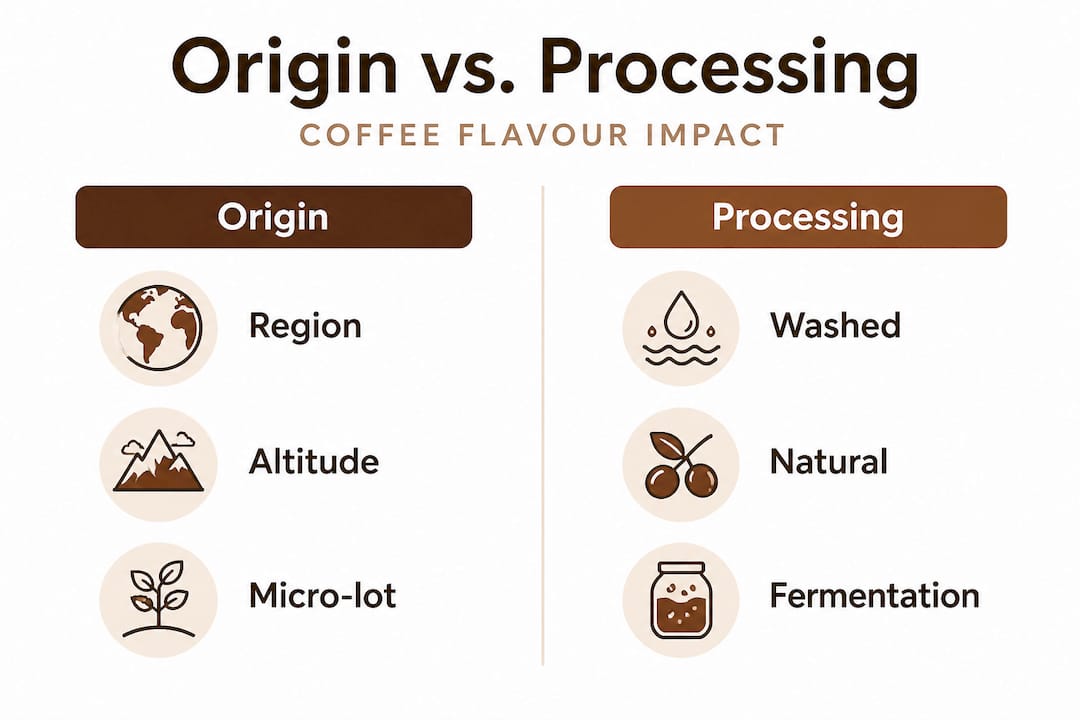
A useful coffee roasting guide for enthusiasts explains how roasters deliberately choose roast profiles to either highlight or soften origin character, depending on the intended market.
Pro Tip: To taste what origin genuinely contributes, choose a washed or traditionally processed single origin bean at light to medium roast. Avoid experimental processing until you have a solid sense of the classic regional profile. Then the contrasts become far more informative.
Having contrasted origin and processing, let us address how nuanced these distinctions can be in practical coffee selection.
Navigating origin as a coffee enthusiast: practical tips
Selecting coffees for origin clarity is a skill that develops with deliberate practice. The information needed is usually on the bag, but knowing which details to prioritise makes all the difference.
- Look for farm or micro-lot identification. A bag labelled simply “Ethiopia” tells you far less than one that names the specific washing station, farm, or co-operative. Farm-specific lots offer more predictable and distinctive flavour.
- Note the processing method. Washed and honey-processed coffees tend to showcase origin more clearly. Natural and anaerobic coffees introduce additional variables.
- Choose light to medium roast for origin clarity. This is the most reliable way to taste what the growing environment contributed.
- Compare coffees from the same origin side by side. This highlights intra-origin variability, which is significant. Not all Ethiopian coffees taste alike.
- Use a brew method that preserves clarity. Pour-over and filter methods are better suited to appreciating origin nuance than, say, a heavily frothed milk drink that will overwhelm delicate notes.
- Read the tasting notes critically. Roasters note expected flavours, but types of coffee beans guide resources remind us that tasting is subjective. Use notes as a guide, not a guarantee.
Understanding UK specialty coffee trends in 2026 shows that British consumers are increasingly interested in traceability, with farm-level sourcing becoming more standard across independent roasters. This makes it easier to access genuinely origin-expressive coffees without travelling far from your kitchen.
Coffee brewing methods explained in detail show that the same origin bean can read quite differently through a French press versus an AeroPress. Understanding what is coffee body helps contextualise these differences: body refers to the physical weight and texture of the liquid in your mouth, which changes with brew method even when origin remains constant.
A common pitfall is assuming all coffees labelled with the same origin taste identical. As origin predictability decreasing with global experimental processing research shows, the landscape is becoming more variable. Two coffees from the same Kenyan region, processed differently, can taste like entirely different origins. Treat origin labels as a starting point, not a complete picture.
Pro Tip: When tasting a new origin for the first time, note three things in sequence: the aroma before brewing, the flavour immediately after the first sip, and the finish. Writing these down builds a personal reference library that makes future comparisons much more accurate.
Now, let us step back and consider the big picture.
Why the conventional wisdom around coffee origin is changing
There is a widely held assumption in coffee circles: buy Ethiopian, get fruit and flowers; buy Brazilian, get nuts and chocolate. That framework was useful once, but it is becoming increasingly unreliable. The coffee world has changed, and the conventional origin map no longer tells the whole story.
Micro-lots are now the more accurate unit of flavour. A named farm at a specific altitude, harvested during a defined window, processed by a consistent method, offers far more predictive value than any country label. National and even regional origin markers are becoming less meaningful as the volume and variety of experimental processing methods increases.
Anaerobic fermentation, extended maceration, and co-fermentation with added fruits or yeasts are producing coffees that sit outside any traditional flavour map. A Colombian coffee fermented with tropical fruit additions may share more in common with a fruit tea than with a classic Huila washed coffee. As noted by research on origin predictability decreasing with global experimental processing, the empirical benchmarks that once validated classic profiles still hold for traditionally processed coffees, but intra-origin variability is rising sharply.
This is not a criticism of innovation. Experimental coffees are exciting and often extraordinary. But enthusiasts who rely purely on origin as their selection guide will increasingly find the experience inconsistent. The better approach is to treat origin as one of several filters: a useful indicator of potential character, confirmed and shaped by processing method, roast level, farm altitude, and harvest year.
Rethinking single origin espresso flavours in this light makes single origin selection a more active and informed process. The enthusiast who asks “which farm, which process, which altitude, which roast?” will find far more consistency and satisfaction than one who asks only “which country?”
The conventional wisdom is not wrong. It is simply incomplete for the coffee landscape of 2026.
Explore origin-driven coffees at Coffee Factory
For those ready to put this knowledge into practice, the range at Coffee Factory offers a practical starting point. Sourcing freshly roasted coffee directly from their Devon roastery, the selection is designed for enthusiasts who care about what is in the bag and where it came from.
Browse the full range of unique coffee varieties to find something suited to your palate. For the clearest origin expression, the single origin coffee collection offers farm-identified and region-specific lots processed to highlight terroir. If you want to taste origin with minimal roast interference, the light roast coffee selection is the most direct route. Free shipping on coffee orders over 1kg applies across all coffee categories.
Frequently asked questions
Can origin really affect coffee flavour more than roasting or brewing?
Yes, scientific studies confirm that origin influences key flavour compounds including volatiles and chlorogenic acids at a foundational level, though heavy roasting can overwrite these characteristics.
How do I choose coffee that really expresses its origin?
Select single origin beans with farm or micro-lot details listed on the bag, and opt for light roast with washed or classic processing, as origin predictability research confirms that micro-lot specificity offers the clearest terroir expression.
What role does altitude play in coffee flavour?
Higher altitude correlates with richer, more layered flavour because cooler growing conditions slow maturation and allow beans to accumulate greater concentrations of phenolics and volatile compounds, as confirmed by scientific studies on altitude and flavour.
Why are some coffees labelled as ‘origin’ but taste similar?
Experimental processing methods and dark roast levels can significantly reduce the flavour differences between origins, as research on anaerobic processing confirms that processing-driven flavours can override the natural terroir of even very distinct growing regions.
Beyond altitude: soil, climate and the farm itself
Altitude gets most of the attention, but it is only one part of what a growing environment contributes. Soil, rainfall and the shape of the land all leave their own marks on the bean.
Soil
Volcanic soils are often treated as the benchmark. They drain well and are rich in minerals, and the high-grown coffees of central Kenya, with their blackcurrant acidity, are the classic example. Sandier, less fertile soils, such as those found in parts of Brazil, tend to give lower acidity and a heavier, nuttier cup. Heavy clay that drains poorly can stress the roots and show up as a flat, muddy flavour if the farm is not managed carefully.
Rainfall and temperature swings
When the rain falls matters as much as how much falls. Coffee plants need a clear dry season to trigger flowering, then steady rain while the fruit develops. Erratic rainfall means cherries ripen unevenly, and a mixed harvest gives a less consistent cup. A wide gap between daytime and night time temperatures also slows ripening, which builds acidity and aroma in much the same way altitude does.
Microclimates
Conditions can change across a single farm. A slope that gets less sun, a valley floor that holds cool air overnight, or a stand of shade trees can all alter how the cherries ripen. Two plots on the same estate, processed the same way, can taste noticeably different. This is a big part of why micro-lots are so prized.
Good stress and bad stress
Some pressure on the plant improves the coffee. A moderate dry spell concentrates sugars, and moderate temperature variation builds complexity. Extremes do the opposite: drought leaves cherries underdeveloped, frost damages plants and heavy humidity encourages disease. That is why a reliable origin can still have a disappointing year, and why the same farm can taste different from one harvest to the next.
More questions about origin
Is coffee terroir classified like wine?
No. Wine has long established, legally defined regions and quality tiers. Coffee has no universal system that ranks regions, altitudes or soils. Labels can therefore be vague, but it also means lesser known regions can still produce outstanding coffee that has not yet built a reputation.
Should I choose a single origin or a blend for espresso?
It depends on what you want from the cup. Blends are built for balance and consistency, which makes them dependable for daily drinking and milk drinks. Single origins put one place front and centre, and they can shift a little from harvest to harvest. Many home baristas keep one of each: a blend for busy mornings and a single origin for when there is time to pay attention.
Do single origins work in milk drinks?
Some do very well. Lower acidity coffees with chocolate and nut notes, such as many from Brazil, hold up nicely in a flat white or cappuccino. Bright, high acidity East African coffees often show their character best as a straight espresso, since milk can mute their delicate notes.
Do I need to change my grind when switching origins?
Often, yes. A bright, high acidity coffee can taste sharp as espresso, and a slightly coarser grind may soften it. A dense, low acidity bean may need a finer setting to draw out its full sweetness. Small adjustments and tasting as you go work best.
Recommended
- Origin coffee beans: flavours, types and heritage 2026
- Coffee brewing methods: flavour and extraction explained
- What is coffee body? understanding its role in flavour
- Coffee origins decoded: assess and appreciate specialty brews