

How coffee origin shapes every cup's flavour
TL;DR:
- Coffee from farms at the same altitude and variety can taste vastly different due to unique environmental conditions known as terroir. Understanding factors like soil, altitude, climate, and microclimates enhances appreciation of coffee’s flavour origins and guides selection and brewing. Roasting level, freshness, and proper label-reading deepen the connection between terroir and tasting experience.
Coffee grown two farms apart, at the same altitude, from the same variety, can taste entirely different. That surprises most people. The assumption is that quality is quality, and a well-roasted bean is a well-roasted bean. The reality is that coffee terroir refers to the unique environmental conditions in which coffee is grown, including soil composition, altitude, climate, microclimates, and surrounding ecosystem, all of which collectively shape flavour precursors, bean density, ripening speed, and the final taste in your cup. Understanding this transforms how you choose, brew, and appreciate coffee.
Table of Contents
- What is coffee terroir?
- How growing conditions shape coffee flavour
- Microclimates, edge cases and the complexity of defining terroir
- Practical tips for UK coffee enthusiasts: finding and tasting terroir
- Why understanding terroir transforms your coffee journey
- Explore coffee terroir with The Coffee Factory
- Frequently asked questions
Key Takeaways
| Point | Details |
|---|---|
| Terroir defines flavour | Where and how coffee is grown directly shapes what you taste in your cup. |
| Altitude and soil matter | Higher altitude and mineral-rich soils can bring out unique, vibrant coffee notes. |
| Nuance is everything | Microclimates and even metre-to-metre differences affect how terroir expresses itself. |
| Choose with curiosity | Seeking out origins known for expressive terroir, like Ethiopia and Kenya, offers a richer tasting experience. |
What is coffee terroir?
The word “terroir” comes from the French and is most commonly used in wine. It describes the idea that a place leaves its mark on what grows there. In coffee, the concept applies just as meaningfully, even if it is less well known.
Coffee terroir covers the full set of environmental conditions surrounding a coffee plant: the soil it grows in, the altitude of the farm, the temperature range across the year, rainfall patterns, humidity levels, and even the plants and trees nearby. Each of these variables changes the chemistry inside the coffee cherry. That chemistry is what you taste.
For anyone curious about how origin shapes the taste in their cup, terroir is the starting point. It explains why an Ethiopian Yirgacheffe tastes of jasmine and lemon curd, while a Colombian from Huila tastes of red apple and caramel, even if both are washed and lightly roasted.
The key components of coffee terroir include:
- Soil composition: Mineral content, drainage, organic matter, and pH level
- Altitude: Metres above sea level, which affects temperature and ripening rate
- Climate: Annual temperature ranges, rainfall distribution, and seasonal patterns
- Microclimates: Highly localised variations in weather and temperature within a single farm or valley
- Surrounding ecosystem: Shade trees, biodiversity, and proximity to water sources
“Understanding terroir is not about memorising geography. It is about connecting what is in your cup to the land where the plant spent years growing.”
Knowing these components helps you read coffee labels with more purpose. It also makes exploring coffee bean origins and flavours a genuinely rewarding exercise rather than a guessing game.
How growing conditions shape coffee flavour
Knowing that terroir matters is one thing. Understanding exactly how each variable changes what ends up in the cup is where things get specific and genuinely useful.
Altitude
Altitude is one of the most measurable and reliable indicators of coffee quality. Higher altitudes slow cherry ripening due to cooler temperatures, leading to denser beans with more complex sugars, brighter acidity, and higher concentrations of phenolic compounds. Research confirms that caffeine content decreases with increasing altitude, while total phenolic content rises significantly, with studies showing a correlation coefficient of r=0.816 for caffeine and altitude in Robusta. Higher altitude farms consistently produce beans that score above 80 points on the Specialty Coffee Association scale.
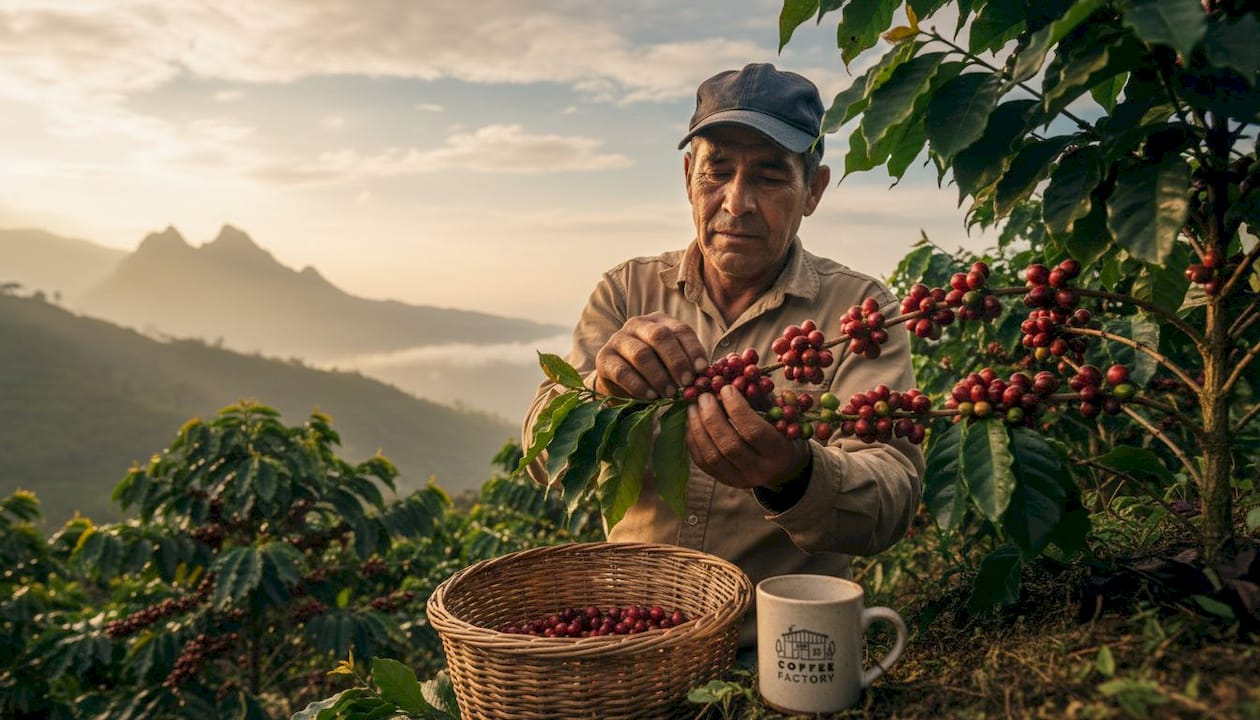
Lower altitude farms produce beans that ripen faster. Faster ripening means less time for sugars and acids to develop. The result is often a softer, less complex cup with lower acidity and more muted flavour notes.
Soil
Volcanic soils are the benchmark for quality. Regions like Kenya’s central highlands sit on ancient volcanic ash, which creates a mineral-rich environment that produces the characteristic blackcurrant acidity Kenyan AA coffees are famous for. The soil drains well, provides specific nutrients, and supports the deep root systems that allow coffee plants to access water during dry periods.
Non-volcanic soils can also produce excellent coffee, but the flavour profile tends to differ. Sandy loams in parts of Brazil produce lower acidity and heavier body. Clay-rich soils in some Central American regions can restrict drainage, affecting root health and nutrient uptake in ways that appear in the cup as muddiness or flatness if poorly managed.
Climate and rainfall
Rainfall timing matters as much as total volume. Coffee plants need a distinct dry season to trigger flowering, followed by consistent rainfall during fruit development. Regions that receive erratic rainfall produce inconsistent cherry ripening, which creates mixed flavour profiles within a single harvest. Ethiopia’s two distinct seasons, for example, support a predictable and expressive flowering cycle, contributing to the reliable floral character in its coffees.
Temperature fluctuation between day and night, known as diurnal temperature variation, is another key factor. Greater variation slows ripening further, builds acidity, and allows more aromatic compounds to accumulate inside the cherry.
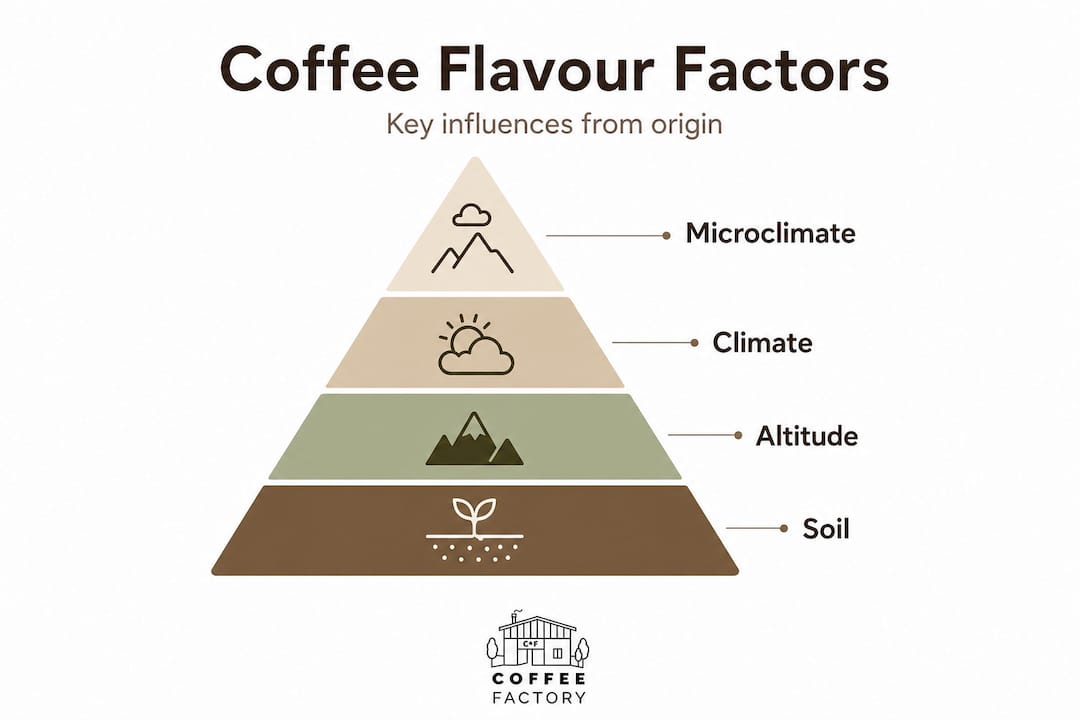
Here is a summary of how the main terroir factors affect bean structure and taste:
| Factor | Effect on bean | Effect on flavour |
|---|---|---|
| High altitude (above 1,500m) | Denser bean, slower ripening | Brighter acidity, more complexity |
| Low altitude (below 900m) | Softer bean, faster ripening | Mild, less complex, heavier body |
| Volcanic soil | High mineral content, good drainage | Sweetness, clarity, mineral edge |
| Sandy/loam soil | Lower nutrient density | Softer, nuttier, lower acidity |
| High rainfall with dry season | Consistent cherry development | Floral, fruit-forward, clean |
| Erratic rainfall | Uneven ripening | Flat, inconsistent, variable |
| High diurnal temperature range | Slow sugar development | Complex, layered, aromatic |
Pro Tip: When choosing a single origin espresso, look for farms listed above 1,800 metres in the origin notes. This elevation is a reliable predictor of the brightness and complexity that comes through even in a concentrated shot.
It is also worth noting that roasting plays a role in preserving or masking terroir characteristics. A very dark roast can overpower the subtle acids and aromatics that altitude and soil have produced. Lighter roasts, by contrast, tend to preserve and highlight those terroir-driven qualities. Understanding roast level effects alongside origin helps you make better purchasing decisions.
Microclimates, edge cases and the complexity of defining terroir
The major growing factors provide a useful framework. But coffee terroir becomes genuinely complex when you factor in microclimates and the absence of any standardised classification system.
Microclimates within a single farm
A microclimate is a highly localised set of weather conditions that can differ dramatically from the surrounding area. On a large coffee farm, the north-facing slopes might receive less direct sunlight, keeping temperatures lower and ripening slower. The valley floor might collect cool air overnight, creating heavier morning mist. Even a cluster of shade trees can alter humidity levels enough to change flavour.
Microclimates can cause flavour variation even metres apart. Two plots on the same estate, processed identically, can taste noticeably different. This is one reason that micro-lot coffees, sourced from a specific section of a farm rather than the entire harvest, are so sought after in the speciality sector.
No classification system, unlike wine
Wine terroir has centuries of codified classification behind it. Burgundy’s Premier Cru and Grand Cru designations, for example, reflect legally defined parcels of land with established reputations for quality. Coffee has no equivalent system globally. There is no universal terroir classification that ranks growing regions, altitudes, or soil types in a standardised way.
This is both a limitation and an opportunity. It means labels can be vague or misleading. It also means there are still discoveries to be made. A region that has not yet built a reputation might produce exceptional terroir-driven coffee that simply has not had the exposure.
Some useful reference points for terroir quality include:
- Kenya AA, Nyeri or Kirinyaga: Volcanic soil, high altitude, distinct berry and blackcurrant character
- Ethiopia Yirgacheffe or Guji: Heirloom varieties, high altitude, jasmine and stone fruit notes
- Colombia Huila or Nariño: High elevation, diurnal variation, caramel and red fruit
- Guatemala Huehuetenango: Isolated microclimate, cool dry winds, complex fruit and chocolate
Optimal stress versus damaging stress
There is an important distinction between stress that improves coffee and stress that damages it. Moderate water stress during the dry season concentrates sugars in the cherry. Moderate temperature variation builds complexity. These are forms of beneficial stress.
Extremes, however, cause defects. Severe drought leads to underdeveloped cherries. Frost kills plants or causes premature ripening. Excessive humidity encourages fungal disease. Understanding this balance helps explain why a particular harvest from a reliable origin can sometimes disappoint.
“The best terroir is not the most extreme terroir. It is the most balanced combination of conditions that allows the plant to thrive under just enough pressure to produce complex, well-developed fruit.”
The science behind how roasting then interacts with these compounds is worth understanding. Coffee degassing after roasting, for instance, affects how volatile aromatic compounds are preserved, and these compounds are partly determined by the original growing conditions. Similarly, coffee body and flavour in the cup are both products of terroir and processing, not just roasting technique.
Practical tips for UK coffee enthusiasts: finding and tasting terroir
Appreciating terroir is a learnable skill. It does not require professional training. It requires attention, some basic label-reading, and a willingness to compare.
Here is how to start:
- Look for altitude on the label. Any bag listing the farm elevation in metres is a positive sign. Above 1,800 metres generally signals a terroir-expressive coffee. High-altitude washed Ethiopians or Kenyans are excellent benchmarks for floral and citrus-driven terroir.
- Note the processing method. Washed coffees tend to express terroir most clearly because the fruit pulp is removed before drying, leaving fewer processing flavours to compete with the bean’s natural character.
- Choose single origin over blends. Blends are designed for consistency and balance. Single origin coffees are designed to showcase the specific character of one farm or region. They are the clearest window into terroir.
- Compare two origins side by side. Buy a Kenyan AA and an Ethiopian Yirgacheffe at the same time. Brew both with the same method. Take notes. The differences are not subtle once you know what to look for.
- Trust your notes over the bag copy. Write down what you actually taste: fruit, nuts, acidity level, sweetness, body. Then compare to the tasting notes on the bag. This calibrates your palate over time.
- Benchmark against volcanic soil origins. Scientific research confirms altitude’s measurable impact on bean biochemistry. Kenya and Ethiopia, both growing on volcanic soils at altitude, are the clearest examples of terroir expressing itself in the cup.
Pro Tip: When cupping at home, use the same water temperature, grind size, and brew ratio for each origin. Any variation in method will make it harder to isolate what the terroir is actually contributing to the flavour.
Seasonal single origin releases are worth tracking. Terroir is not static. A farm at the same altitude in the same region will taste different across harvests depending on that year’s rainfall and temperatures. Following a specific origin across multiple seasons gives a much richer sense of what the place consistently contributes versus what shifts with conditions.
Why understanding terroir transforms your coffee journey
There is a risk in learning about terroir. The risk is that it becomes a collecting habit rather than a tasting one. Some coffee enthusiasts start chasing high-altitude micro-lots from obscure regions not because the coffee speaks to them, but because the label sounds impressive. That is the wrong direction.
Terroir knowledge is most useful when it builds a direct connection between what is in the cup and why it tastes that way. Knowing that a Kenyan coffee tastes of blackcurrant because of the volcanic soil and washed processing gives that flavour a context. It makes the experience richer without requiring the coffee to be expensive or rare.
The other common mistake is dismissing coffees that do not fit the high-altitude, volcanic-soil template. Lower-altitude Brazilian naturals, for example, express their own form of terroir through heavy body, chocolate, and nut notes. That terroir is less dramatic but equally genuine. Judging it against a Kenyan AA is like judging a sturdy loaf of bread against a pastry.
The most productive approach is curiosity without hierarchy. Try coffees from different regions and elevations. Note what you actually prefer rather than what you think you should prefer. Use terroir as a framework for understanding, not a ranking system for prestige.
Finally, keep in mind that terroir is only part of the story. Processing, storage, freshness, roast level, and brewing method all intervene between the farm and the cup. A terroir-expressive bean, stale on the shelf or over-roasted, will not deliver what the land promised. Freshness matters enormously in making terroir legible in the final brew.
Explore coffee terroir with The Coffee Factory
The Coffee Factory roasts fresh to order from their Devon roastery, shipping directly to UK doors. For anyone ready to taste terroir differences in practice, the range offers a clear starting point.

The single origin collection includes coffees from key terroir-expressive regions, each labelled with origin details to help you connect the geography to the flavour. For a structured way to explore across multiple origins over time, a coffee subscription rotates through seasonal and single origin options, making it straightforward to compare what different growing conditions actually taste like in the cup. Free shipping is available on orders over £20.
Frequently asked questions
How does coffee terroir compare to wine terroir?
Coffee terroir is less codified than wine, with greater small-scale variation due to microclimates and no universal classification system equivalent to wine’s established regional designations. This makes coffee terroir both harder to define and more open to discovery.
Does altitude always mean better coffee?
Higher altitudes yield denser beans with more complex flavour compounds, but altitude alone does not guarantee quality. Soil composition, climate patterns, processing method, and roast all contribute significantly to the final cup.
Can I taste terroir differences in supermarket coffee?
Most mass-produced supermarket blends are designed for consistency rather than origin expression, which masks terroir-driven flavours. Single origin and speciality roasts are where origin character becomes clearly perceptible.
What are some top origins for tasting terroir?
Kenya and Ethiopia are the most reliable benchmarks, with Kenya’s blackcurrant acidity and Ethiopia’s jasmine and floral notes both products of high altitude and volcanic soil. Colombia and Guatemala are also excellent choices for distinct terroir-driven profiles.