

Why coffee degassing matters: science and steps after roasting
TL;DR:
- Degassing is a natural release of CO₂ from roasted coffee beans, not staling.
- Rest periods vary based on roast level, equipment, and storage, typically 1-14 days.
- Proper timing improves flavour extraction and reduces issues like sourness and uneven brewing.
Fresh coffee straight from the roaster sounds like the ideal choice. Yet brewing beans too soon after roasting often produces a flat, sour, or uneven cup. The reason is degassing, a natural chemical process that happens inside every roasted bean. Many coffee enthusiasts either ignore it or follow blanket advice without understanding why rest periods matter. This guide covers the science behind degassing, how different roast levels and brewing methods change the equation, and practical steps to get the best flavour from every bag.
Table of Contents
- What is coffee degassing and why does it happen?
- The science of degassing: chemistry inside the bean
- How roast level, grind size and brewing method impact degassing
- Practical tips: how to manage degassing for the best cup
- Why coffee degassing is still misunderstood (and what most people miss)
- Explore unique coffees and expert guidance with Coffee Factory
- Frequently asked questions
Key Takeaways
| Point | Details |
|---|---|
| Degassing is essential | Letting coffee rest after roasting releases excess CO₂ and improves flavour. |
| Rest period varies | Most coffees need 48–72 hours, but roast level and method influence the optimal wait. |
| Variable factors matter | Roast type, grind size, and brewing method all affect how you should handle degassing. |
| Monitor and adjust | Watch your results and tweak rest times for your preferred brewing style. |
What is coffee degassing and why does it happen?
Degassing refers to the release of gases, primarily carbon dioxide (CO₂), from roasted coffee beans after they leave the roaster. It is not a sign of poor quality. It is a predictable, natural part of the coffee’s journey from green bean to finished cup.
During roasting, the application of intense heat triggers a series of chemical reactions inside the bean. The most significant of these is the Maillard reaction, which generates flavour compounds, colour changes, and large volumes of CO₂. The bean structure traps much of this gas. Once removed from the heat and allowed to cool, the beans begin to release that trapped CO₂ gradually over hours and days.
Why this matters for brewing:
- Excess CO₂ interferes with water absorption during extraction, leading to uneven brewing
- Too much gas creates a barrier between water and coffee grounds, preventing consistent flavour release
- Espresso brewed from very fresh beans produces excessive crema that quickly collapses, indicating gas rather than actual emulsified oils
- Filter and pour-over methods show similar problems: uneven bloom, channelling, and sour or underdeveloped taste notes
The key distinction worth making is that degassing is not staling. Staling is oxidation, the process that makes coffee taste flat and cardboard-like when it is left exposed to air too long. Degassing is the opposite situation. It is the bean releasing something it produced during roasting, a temporary state that resolves with time.
Understanding the flavour science of roasting helps clarify why roasting creates so much gas in the first place. The reactions that build flavour also build CO₂, so more complex roasting processes often produce more gas to release.
“Coffee takes 48 to 72 hours to de-gas before it settles for more even extraction.” This broadly accepted benchmark gives home brewers a practical starting point, though the full picture is more nuanced.
Most of the CO₂ escapes within the first few days, but trace amounts continue to leave the bean for up to two weeks, depending on roast style, bean density, and storage conditions. Getting this timing right is the difference between a balanced, well-extracted cup and one that frustrates despite using high-quality beans.
The science of degassing: chemistry inside the bean
Now that you understand degassing basics, it helps to look at what is happening inside every roasted bean at a chemical level.
When green coffee is roasted, it undergoes dramatic structural changes. The bean expands, loses moisture, and its cellular walls break down and reform. During this process, CO₂ is produced through several reactions, most notably the Maillard reaction and the caramelisation of sugars. Roasted beans can contain between six and ten litres of CO₂ per kilogram of coffee. Most of this is trapped inside the bean’s porous cellular structure.
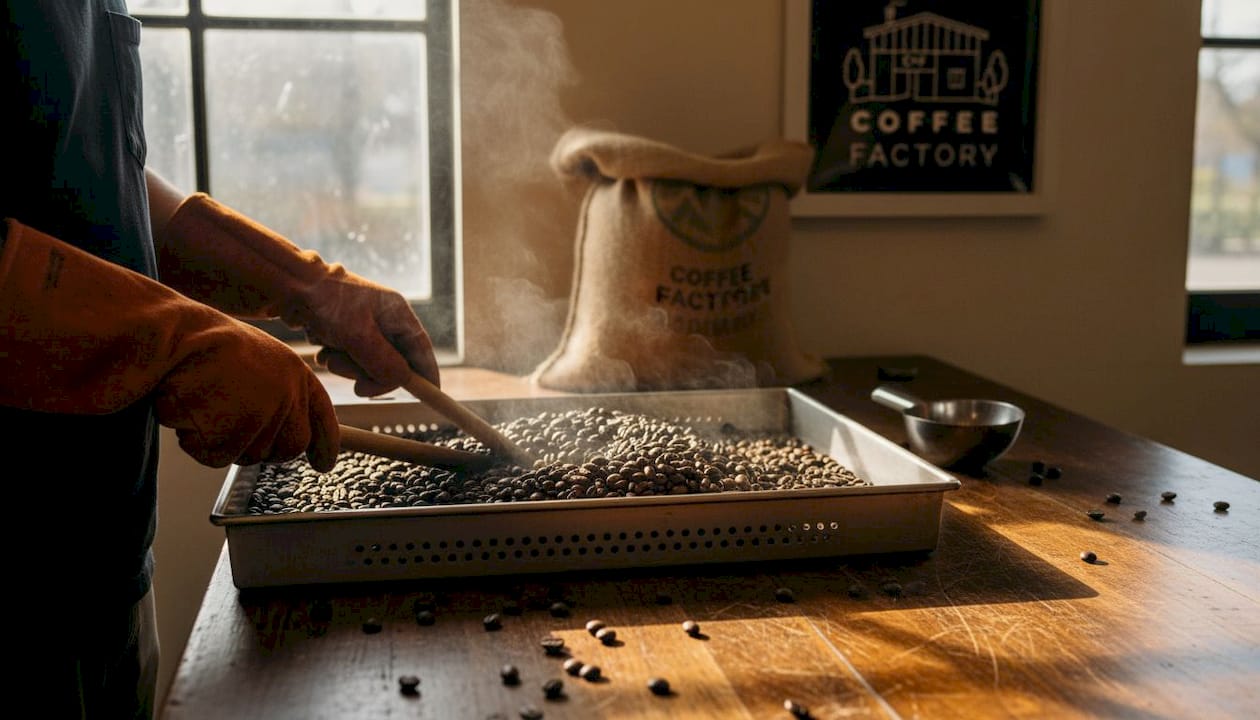
After roasting, CO₂ exits in two ways: quickly from the surface and more slowly from the dense interior. This is why you see so much outgassing in the first 24 hours. The outer layers release their gas almost immediately, while the inner structures take considerably longer.
Different roast profiles and roasting equipment affect how quickly this happens. Drum roasters, which tumble beans in a rotating cylinder, produce a denser roast with more intact cellular structure. Fluid-bed roasters, which use hot air to suspend and roast beans, tend to produce a more porous bean that releases gas faster. The practical implication: fluid-bed roasted coffees may need slightly less resting time than drum-roasted equivalents.
Roast level also plays a central role. Lighter roasts retain more of the bean’s original structure, meaning CO₂ is released more slowly. Darker roasts have more fractured cellular walls, which lets gas escape faster but also leaves the bean more vulnerable to oxidation afterwards.
| Roast type | Degassing rate | Typical rest recommendation |
|---|---|---|
| Light roast (drum) | Slow | 5 to 14 days |
| Medium roast (drum) | Moderate | 3 to 7 days |
| Dark roast (drum) | Fast | 1 to 3 days |
| Light roast (fluid-bed) | Moderate to fast | 3 to 7 days |
| Dark roast (fluid-bed) | Very fast | 1 to 2 days |
These ranges are guidelines, not fixed rules. Bean density, altitude of origin, and processing method all influence the curve. High-altitude beans tend to be denser, which slows gas release further.
Pro Tip: If you source coffee from a roaster using fluid-bed equipment, reduce your usual rest time by roughly 30 to 40 percent. Tasting a small batch at different rest intervals is the most reliable way to find the ideal window for a specific coffee. Knowing your coffee roast levels gives important context when dialling in rest periods.
Some roasters and workflows challenge the conventional wisdom on rest times. Certain roasting approaches suggest shorter waits depending on roast method and workflow, particularly for darker roasts or espresso blends designed to be used quickly. This is a useful reminder that rest time advice should always be matched to the specific product and process in question.
How roast level, grind size and brewing method impact degassing
With the science in mind, it is vital to see how practical variables shape your cup.
Roast level is perhaps the most significant variable. Dark roasts degas quickly because the roasting process has fractured the bean’s cellular walls, creating easy exit routes for CO₂. This means a dark espresso blend might be ready to brew within 24 to 48 hours of roasting. Light roasts, by contrast, retain their dense structure and release CO₂ much more slowly. A light roast filter coffee might need five to ten days of rest before flavour compounds are fully accessible to hot water during brewing. Medium roasts fall in between, typically reaching their optimal window around three to five days post-roast.
Grind size introduces another layer of complexity. When whole beans are ground, the cellular structure is broken open and exposed. This dramatically accelerates degassing. A fine espresso grind has an enormous surface area, so CO₂ exits rapidly after grinding. This is part of the reason grind-on-demand is so strongly recommended: grinding too far in advance, even with rested beans, allows excessive gas loss and accelerates staleness. For coarser grinds used in French press or cold brew, the surface area is smaller and degassing after grinding is somewhat slower, though still significant.
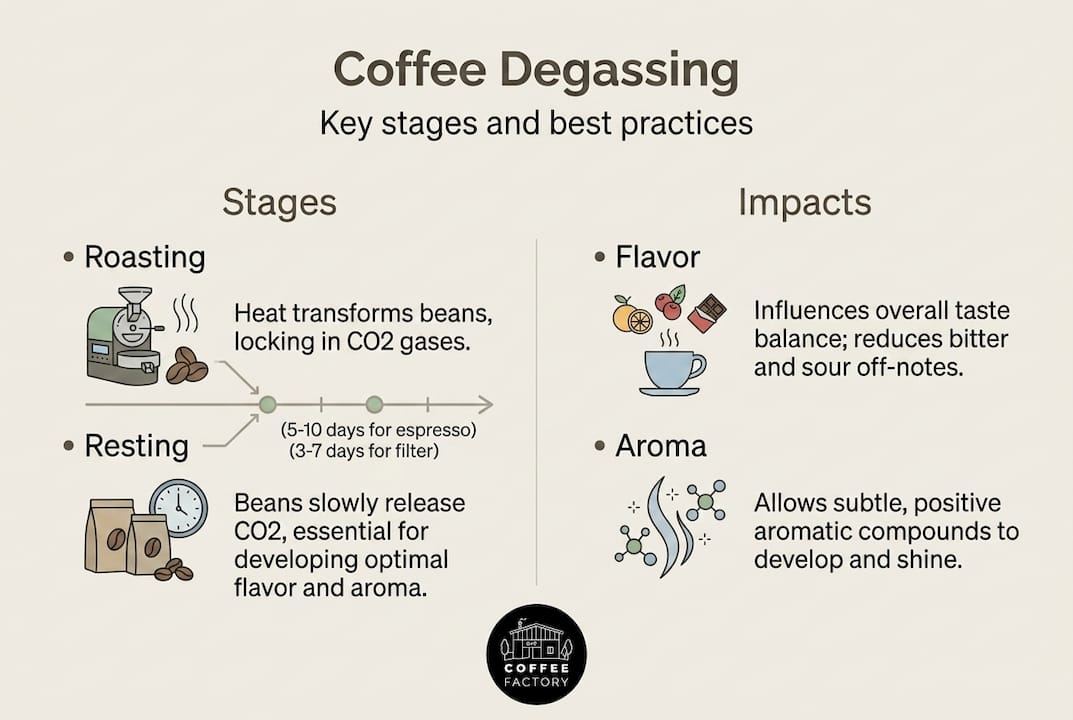
Understanding your roast levels and flavour profiles helps pair the right rest period with the right grind. Consulting a quick brew guide alongside this knowledge gives a more complete picture for each method.
| Roast level | Brewing method | Recommended rest |
|---|---|---|
| Dark | Espresso | 1 to 3 days |
| Medium | Espresso | 3 to 5 days |
| Light | Espresso | 5 to 10 days |
| Dark | Filter / pour-over | 2 to 5 days |
| Medium | Filter / pour-over | 4 to 7 days |
| Light | Filter / pour-over | 7 to 14 days |
Signs your coffee may need more resting:
- Bloom is very vigorous, rising significantly and quickly during pour-over
- Espresso shot pours very fast with large, unstable crema
- Taste is sour, sharp, or lacks sweetness
- Extraction feels uneven across the puck
Signs your coffee may have rested too long:
- Bloom is minimal or non-existent during filter brewing
- Espresso pulls sluggishly or tastes flat and lifeless
- Flavour notes are muted or cardboard-like
- Aroma is noticeably weaker than expected
For those brewing single origin espresso, the rest period is particularly important. Single origin coffees used for espresso, explored in more detail in single origin espresso tips, often require longer rest than commercial blends because they tend to be lighter in roast and denser in bean structure. The 48 to 72 hour benchmark is often not sufficient for these coffees in espresso brewing.
Practical tips: how to manage degassing for the best cup
Now that you know the variables, here is how to apply this knowledge for the best home coffee results.
Degassing is not something to leave entirely to chance. With a few intentional steps, it is entirely manageable. The goal is to brew coffee in its optimal window: after most CO₂ has escaped but before oxidation begins to degrade the flavour compounds.
Step-by-step guide from roast day to first brew:
- Note the roast date. Most quality roasters, including those dispatching beans direct from their roastery, print this clearly on the bag. Use this as your reference point, not the best-before date.
- Store beans whole, not pre-ground. Keep them in an airtight container away from light, heat, and moisture. Whole beans retain their structure and degas more slowly, giving you a wider usable window.
- Wait according to roast level. Use the rest period tables as a starting guide. Dark roasts for espresso: 1 to 3 days. Light roasts for filter: up to 14 days.
- Test with a small batch. Brew a single cup at day three and again at day seven. Compare the bloom, extraction behaviour, and taste. This is the most accurate way to identify peak rest for a specific coffee.
- Grind only what you need, immediately before brewing. This preserves the rest of the batch in its optimal whole-bean state. Pre-grinding the entire bag accelerates both degassing and staling.
- Adjust for batch size. Larger batches may need slightly longer resting, particularly if beans are stored in a very full, sealed container where escaping CO₂ builds up around the beans.
Good storage is central to managing degassing correctly. Detailed guidance on storing for freshness covers the equipment and conditions that best support the rest period. Keeping beans in a one-way valve bag (the kind most quality roasters use) is particularly effective. The valve allows CO₂ to escape without letting oxygen in, which is exactly the right balance during the rest period.
Pro Tip: Use different rest periods for filter and espresso when working from the same bag. Pull your espresso shots earlier in the rest window and switch to filter brewing as the bag ages further. This approach extracts maximum value and flavour from every batch.
Consulting a detailed brewing guide alongside your rest schedule brings the full picture together, from dose and grind to water temperature and timing.
The 48 to 72 hour standard for degassing is widely cited and broadly useful, but treating it as an absolute rule misses the nuance that separates a good cup from a genuinely excellent one.
Why coffee degassing is still misunderstood (and what most people miss)
The specialty coffee world has done a good job of spreading the message that very fresh roasted coffee needs rest. But the follow-through advice is often too rigid. “Wait 48 hours” gets repeated as though it applies equally to every roast, every method, and every setup. It does not.
The more inconvenient truth is that optimal rest is specific. A 48-hour rest might be ideal for a dark espresso blend and completely inadequate for a washed Ethiopian light roast brewed as filter. Following blanket advice without adjusting for your actual coffee and setup leads to consistently mediocre results despite using excellent beans.
Industry experience shows that brewers who dial in their rest periods bean by bean, and who treat tasting across the rest window as a routine rather than an inconvenience, consistently produce better results. This approach also changes how you choose coffee. When you understand degassing properly, you pay closer attention to choosing fresh coffee beans with clear roast dates, because that information becomes genuinely useful rather than decorative.
Some roasters are now suggesting shorter waits depending on their specific roasting method and workflow, which is a healthy sign that the conversation is becoming more nuanced. Context, as always, matters more than a fixed rule.
Explore unique coffees and expert guidance with Coffee Factory
If you are ready to put degassing knowledge into practice, the starting point is sourcing coffee with a clear roast date from a roaster who takes freshness seriously.

The Coffee Factory, based in Devon, dispatches freshly roasted beans directly to your door across the UK. Browse a curated range of unique coffee varieties including single origins and seasonal blends, each roasted to order. Prefer convenience? Fresh ground coffee options are available for those who want ready-to-brew quality. For ongoing freshness without the effort of repeat ordering, explore coffee subscriptions tailored to your preferred frequency and roast style. Free shipping on coffee orders over 1kg.
Frequently asked questions
How long should I let coffee rest after roasting?
Most experts recommend waiting 48 to 72 hours after roasting before brewing to allow CO₂ to escape, though lighter roasts or filter brewing often benefit from resting up to 14 days for balanced extraction.
Does degassing affect all coffee types equally?
No, degassing rates differ significantly between light, medium, and dark roasts and are also influenced by roasting equipment and grind size. Some roasters suggest shorter waits depending on the specific roast method and intended brewing workflow.
How do I know if coffee is under-degassed?
Vigorous blooming, very fast espresso pours, or a sour and sharp taste in the cup are reliable indicators of excess CO₂. Waiting an additional two to three days and retesting usually resolves this. A standard 48 to 72 hour rest is a useful minimum starting point.
Can I drink coffee immediately after roasting?
You can, but most brewers find the flavour less balanced and extraction uneven due to excess CO₂ competing with water during brewing. The 48 to 72 hour rest period is widely recommended as the minimum for a more consistent and enjoyable cup.
Recommended
- Why coffee beans are roasted: flavour science explained
- Coffee roast levels: how they shape flavour and brewing
- What is a roastery? Elevate your home coffee in 2026
- How to choose coffee beans: 73% prefer fresh roasted
- Artisan coffee roasted in Devon
- Meet our vintage Probat roasters
- Uncover Devon's Best Coffee: A Deep Dive into the Specialty Coffee Roasters You Can't Miss
- What is artisan coffee? Discover craftsmanship in 2026