

Ethical sourcing in coffee: a complete guide for UK buyers
TL;DR:
- Labels like “ethically sourced” or “certified organic” do not ensure fair wages or the elimination of forced labour in coffee supply chains. Genuine ethical sourcing involves ongoing verification of wages, safety, environmental practices, and full traceability from farm to cup. Consumers should prioritise transparency, direct relationships, and supply chain accountability over certifications alone to make truly informed, ethical coffee choices.
Picking up a bag labelled “ethically sourced” or “certified organic” feels like a responsible choice. But that label does not guarantee the workers who picked your coffee beans were paid a living wage, or that forced labour risks have been fully eliminated from the supply chain. Certifications can be costly for smallholder farmers, premiums do not always cover true living costs, and fragmented supply chains create gaps that even well-intentioned certifications cannot always close. This guide breaks down what ethical sourcing actually means, how it works in practice, and how UK consumers can make genuinely informed choices.
Table of Contents
- What does ethical sourcing in coffee mean?
- How ethical sourcing works: from farm to cup
- Navigating certifications and hidden challenges
- How to choose ethical coffee: tips for UK buyers
- Why ethical sourcing is more complex than it seems
- Discover your next ethically sourced coffee
- Frequently asked questions
Key Takeaways
| Point | Details |
|---|---|
| Certifications aren’t everything | Some ethical coffees lack certification yet adhere to high standards. |
| Traceability is essential | True ethical sourcing follows coffee from farm to cup with transparency. |
| Regenerative leads the future | Emerging regenerative standards raise the bar for coffee’s impact on climate and biodiversity. |
| Ask the right questions | UK buyers can drive real change by questioning supply chain practices. |
What does ethical sourcing in coffee mean?
Ethical sourcing is not simply a matter of ticking boxes on a certification form. At its core, it is about ensuring that every person involved in producing your coffee, from the farmer tending seedlings to the worker processing cherries at a wet mill, is treated fairly, works in safe conditions, and receives fair economic reward.
For UK consumers who care about impact, this distinction matters. Certifications like Fair Trade or Rainforest Alliance provide a useful starting point, but they are frameworks, not guarantees. Understanding fair trade standards helps clarify what is actually being promised and what remains outside the scope of any given label.
Genuine ethical sourcing involves the following practical commitments:
- Child labour bans, with verified age checks at the farm and processing level
- Proper wages, ideally benchmarked against living wage data for the producing region
- Safe working conditions, including access to protective equipment and medical care
- Environmental controls, covering water use, pesticide management, and soil health
- Full traceability, meaning the roaster can identify the specific farm or cooperative the coffee came from
- Grievance mechanisms, so workers and farmers have a formal route to raise concerns
Practical due diligence steps include checklists for wages, working hours, child labour bans, environmental controls, and traceability to farm or village level. These are not one-off exercises. They require ongoing review cycles and verification that premiums are actually reaching the producers.
“Ethical sourcing is a process, not a destination. Without continuous due diligence, standards slip and the human cost is carried by the most vulnerable people in the chain.”
Pro Tip: When evaluating a roaster’s ethical credentials, ask specifically whether they can trace their coffee to a named farm or cooperative. If the answer is vague, the supply chain transparency is limited.
UK buyers are increasingly demanding proof, not just claims. This is reflected in growing consumer interest in single-origin and direct-trade coffee, where the relationship between roaster and producer is documented and visible.
How ethical sourcing works: from farm to cup
Knowing the principles is step one. Understanding how ethical sourcing is actually put into action in the real world is where things get more detailed and, at times, more complicated.
Here is a practical breakdown of the steps involved:
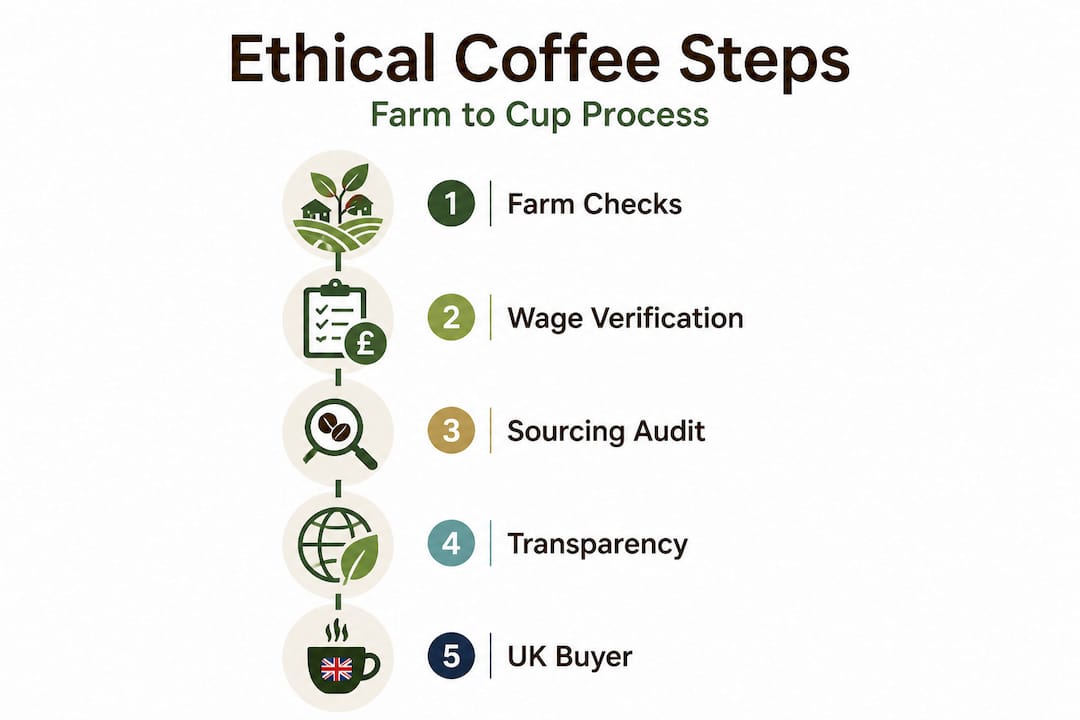
- Mapping the supply chain. The roaster identifies every supplier, intermediary, and farm involved in producing a given lot of coffee. This includes exporters, dry mills, wet mills, and individual farmers or cooperatives.
- Self-assessments and audits. Suppliers complete self-assessment questionnaires covering labour practices, environmental management, and pay structures. Independent auditors then verify these claims on-site.
- Corrective action plans. Where issues are found, a corrective action plan is agreed and monitored over time. This is not a one-and-done process.
- Premium verification. The roaster checks that any price premium paid above the commodity floor actually reaches the intended recipients, whether that is a cooperative, a farmer group, or individual workers.
- Consumer-facing transparency. The roaster publishes sourcing information, including farm names, producing regions, and any relevant audit outcomes, so buyers can assess the claims independently.
Traceability to farm or village level, combined with ongoing due diligence cycles, is what separates a genuinely ethical supply chain from a marketing claim. Traceable coffee practices give buyers a clear line of sight from roastery to origin.
In the UK, sourcing practices are also shaped by legislation. The Modern Slavery Act 2015 requires larger businesses to publish annual statements on steps taken to prevent modern slavery in their supply chains. Responsible sourcing regulations are shifting from voluntary commitments towards strategic compliance frameworks, with real consequences for businesses that fall short.
| Stage | Key activity | Why it matters |
|---|---|---|
| Farm level | Labour checks, wage verification | Ensures workers are paid fairly |
| Processing | Environmental audits | Controls water use and waste |
| Export | Traceability documentation | Links product to specific origin |
| Import/roastery | Premium verification | Confirms producers receive agreed payments |
| Consumer | Transparency reporting | Allows buyers to assess claims independently |
Pro Tip: Check whether a roaster publishes their sourcing data publicly. Transparency reports or origin pages on a roaster’s website are a reliable indicator of genuine supply chain oversight.
Navigating certifications and hidden challenges
Labels can be misleading. The logo on a coffee bag tells you that a product has met a specific set of criteria at a point in time. It does not guarantee that every element of the supply chain was assessed or that conditions have remained consistent year after year.
Here is a comparison of the major certification schemes relevant to UK coffee buyers:
| Certification | Core focus | Strengths | Limitations |
|---|---|---|---|
| Fair Trade | Price floors and producer premiums | Supports cooperatives financially | Premium may not reach all workers |
| Rainforest Alliance | Environmental and social standards | Broad coverage of farm practices | Auditing frequency varies |
| Organic (Soil Association) | No synthetic inputs | Environmental benefit | Does not address labour rights directly |
| Regenerative Organic | Soil health, biodiversity, and fairness | Broadest standards available | Limited coverage in coffee sector currently |
Regenerative standards emerging from organisations like the Rainforest Alliance emphasise soil health and biodiversity goals that go well beyond basic sustainability requirements. These standards represent a meaningful step forward. However, uptake is still limited, and the added costs of certification are real barriers for smaller producers.
There is also the significant issue of certification costs for smallholders. Many smallholder farms in Ethiopia, Colombia, or Honduras may operate in ways that are genuinely sustainable and free from exploitative practices, yet lack formal certification simply because the fees and administrative requirements are prohibitive. These coffees are sometimes described as “organic by default,” meaning the farming practice is sound but the paperwork is absent.
Key challenges to be aware of:
- Supply chain fragmentation. A single lot of coffee may pass through multiple traders, processors, and exporters before reaching a roaster. Each handoff creates a potential gap in oversight.
- Premium distribution failures. Price premiums paid at the export level do not always flow through in full to individual farmers or workers, particularly in complex cooperative structures.
- Forced labour risks. Forced labour risks remain high in fragmented chains even when certifications are present, because audits cannot cover every touchpoint.
- Audit fatigue. Suppliers facing multiple simultaneous audits from different buyers may prioritise documentation over genuine improvement.
The sustainable coffee guide provides further context on how these standards apply to the UK market and what to look for when selecting a roaster.
“A certification badge confirms that standards were met at a specific moment. It does not guarantee that conditions are unchanged today or that every worker in the chain benefited equally.”
Understanding these limitations is not a reason to dismiss certifications entirely. They represent a meaningful baseline. But they work best when paired with direct relationships, transparency, and ongoing accountability.
How to choose ethical coffee: tips for UK buyers
With labels and standards clarified, here is practical guidance for making confident, ethical choices as a UK consumer.
- Look for full supply chain traceability. A roaster should be able to tell you which farm, cooperative, or washing station produced your coffee. If they can only offer a country of origin, the chain is not fully mapped.
- Ask about sourcing relationships. Direct trade relationships, where a roaster buys directly from a farmer or cooperative without intermediaries, typically offer greater transparency and better producer outcomes.
- Check for grievance mechanisms. True ethical sourcing requires grievance mechanisms so that workers and producers have a documented, accessible way to raise concerns. Ask roasters whether these exist in their supply chains.
- Do not rule out uncertified coffee. Some of the most carefully sourced and sustainably produced coffees carry no formal certification. If a roaster can provide detailed origin information and explain their direct relationships, the lack of a logo is not necessarily a red flag.
- Consider subscription services. Regular subscriptions often develop over time into direct relationships between roasters and producing farms, and roasters are more incentivised to maintain ethical standards when long-term supply agreements are in place.
- Look at the roaster’s transparency. Published sourcing reports, farm profiles, and direct quotes from producers are reliable indicators that a roaster is doing the deeper work rather than relying solely on third-party certification.
The benefits of premium coffee extend beyond flavour. Premium pricing supports better sourcing relationships, encourages transparency, and makes it economically viable for roasters to invest in the due diligence processes described in this guide.
UK regulations like the Modern Slavery Act add further pressure on businesses to demonstrate accountability. As a buyer, you can use this framework to your advantage. Ask roasters directly whether they publish a Modern Slavery statement and what it covers. A roaster who cannot answer that question clearly is worth questioning.
Pro Tip: When a roaster offers limited edition single-origin lots with full farm or cooperative details, this is a good indicator of genuine sourcing relationships. These lots are usually produced in small quantities and require direct negotiation between roaster and producer.
Why ethical sourcing is more complex than it seems
Most UK buyers assume that a certification badge on a coffee bag settles the question of ethics. In practice, the picture is considerably more complicated, and understanding this reality is what separates a genuinely informed consumer from one who is simply buying a feeling of reassurance.
The cost of certification is a real and underappreciated barrier. A smallholder farmer in Rwanda or Guatemala, managing a few hectares of coffee at altitude, may follow practices that are genuinely sound from both an environmental and a labour perspective. But the fees required to certify those practices, combined with the administrative burden, are simply out of reach. The result is that some of the most carefully produced coffees in the world carry no badge at all, while some certified coffees come with supply chain risks that audits have not fully captured.
Premiums are another area where the reality does not always match the marketing. Fair Trade floor prices provide a minimum safety net, but in periods of commodity volatility or when supply chains involve multiple intermediaries, the premium that was supposed to reach a specific farmer can be diluted or redirected before it arrives. This does not make certifications worthless. It means they require active verification rather than passive trust.
Real change in the coffee industry comes from direct relationships, full transparency, and consumer willingness to ask difficult questions. When you ask a roaster where your coffee comes from, how it was processed, and whether the people who grew it were paid a living wage, you are doing more than most buyers ever do. That kind of enquiry creates accountability in a way that no logo can replicate.
The true fair trade impact is real, but it is strongest when certifications are treated as a floor, not a ceiling. The most impactful sourcing programmes go beyond compliance and build genuine, long-term relationships with producers.
Discover your next ethically sourced coffee
The principles covered in this guide are useful only if they connect to practical choices. At The Coffee Factory, sourcing decisions are grounded in transparency and quality, with freshly roasted coffee delivered directly from the Devon roastery to your door.
The fresh ground coffee range covers a curated selection of origins and blends, each with clear sourcing information. For buyers who want ongoing variety while building a relationship with coffees they trust, coffee subscription options offer regular deliveries of freshly roasted coffee with free shipping on orders over £20. Subscriptions also make it easier to explore single-origin lots as they become available through the season, which is often where the most transparent and carefully sourced coffees are found.
Frequently asked questions
Does ethical coffee always mean certified coffee?
No, some ethical coffees are uncertified due to cost barriers but still follow sustainable and fair practices. Certifications are costly for smallholders, meaning many genuinely sustainable farms cannot afford to certify.
How can I check if my coffee brand is truly ethical?
Ask brands about supply chain traceability, worker protections, environmental practices, and how premiums reach producers. Full-chain traceability and documented grievance mechanisms are key indicators of genuine ethical commitment.
Why is forced labour still an issue in ‘ethical’ coffee chains?
Supply chain fragmentation and limited audit coverage mean that risks can persist despite certifications. Forced labour risks remain in fragmented chains even when labels are present, because no audit can reach every touchpoint.
Are regenerative coffees better than standard ethical options?
Regenerative coffees add soil health and biodiversity goals that go beyond basic ethical standards. Regenerative standards emerging within the sector, such as those being advanced by the Rainforest Alliance, represent the most ambitious framework currently available for coffee production.
Recommended
- What is sustainable coffee: a guide for UK enthusiasts
- What is business coffee supply? A 2026 UK guide
- How to order bulk coffee: a UK guide to quality
- Premium coffee guide: expert tips for home and gifting
- Why trace your coffee? The real benefits of transparency – Tri Crow Coffee