

Home barista skills: brew café-quality coffee at home
TL;DR:
- Precision, technique, and systematic adjustments enable home baristas to craft café-quality coffee.
- A high-quality burr grinder is essential for consistent grounds and balanced extraction.
- UK-specific challenges like hard water and limited space foster problem-solving skills that improve brewing results.
Café-quality espresso is not reserved for professionals with commercial machines. A home barista is a coffee enthusiast who brews high-quality, café-style coffee at home using specialised equipment and techniques, particularly espresso-based drinks. Many people assume the gap between a café cup and a home brew is insurmountable, but that assumption is simply wrong. With the right grinder, a solid grasp of extraction principles, and a systematic approach to tasting and adjusting, you can produce espresso and filter coffee that genuinely rivals what your local coffee shop serves.
Table of Contents
- What does it mean to be a home barista?
- Essential home barista equipment
- Core brewing techniques and methodologies
- Solving UK home brewer challenges
- Advanced skills and expert techniques
- What most guides miss about becoming a coffee enthusiast in the UK
- Discover premium UK coffee and barista essentials
- Frequently asked questions
Key Takeaways
| Point | Details |
|---|---|
| Precision matters most | Consistent technique and measurement are the keys to café-quality results at home. |
| Burr grinders are essential | Invest in a burr grinder before any other equipment for superior extraction and flavour. |
| UK-specific solutions | Use water filters and compact setups to address the realities of British home brewing. |
| Stepwise improvement | Tweak one variable at a time and taste your coffee to achieve best results. |
| Learning beats gear | Advanced technique and tasting are more important than expensive machines. |
What does it mean to be a brewing at home?
A home coffee maker is not simply someone who owns an espresso machine. The distinction matters. Casual coffee drinkers press a button and wait. Home baristas adjust grind size, dial in dose and yield, monitor extraction time, and taste critically to identify what needs changing. The approach is deliberate, evidence-based, and iterative.
The comparison to professional baristas is useful but often misunderstood. Professionals operate under commercial volume and pressure, pulling hundreds of shots per day across multiple machine groups. Home baristas, by contrast, lack commercial volume and pressure but can achieve comparable quality through precision and focused attention on each individual cup. Some professional baristas argue the home enthusiast is not a “true barista,” and there is a practical logic to that view. However, precision and passion can close the gap considerably.
Key characteristics of a home brewer include:
- Systematic approach: Change one variable at a time, taste the result, and adjust accordingly.
- Equipment literacy: Understanding what each tool does and why it matters.
- Sensory development: Training the palate to distinguish sourness, bitterness, and balance.
- Continuous learning: Reading, watching, and participating in communities.
“The budding barista journey is defined not by the equipment you own, but by the discipline you bring to each brew.”
Joining online forums, local tasting groups, and following coffee subscriptions for enthusiasts introduces you to a wide community of like-minded brewers. The club duo overview from The Coffee Factory is one practical example of how ongoing bean delivery and tasting notes can accelerate your learning without requiring you to source everything yourself.
Essential home brewer equipment
Understanding the coffee enthusiast mindset is the foundation. The tools are the next step. The good news for UK home brewers is that building a capable setup does not require unlimited counter space or an enormous budget, provided you prioritise correctly.
The most critical piece of kit is a burr grinder, not the espresso machine. This surprises many beginners, who instinctively spend the bulk of their budget on the machine itself. Burr grinders crush coffee between two abrasive surfaces, producing grounds of consistent size. Blade grinders chop randomly, generating a mixture of fine powder and coarse chunks that extract unevenly and produce inconsistent, often bitter or sour cups.
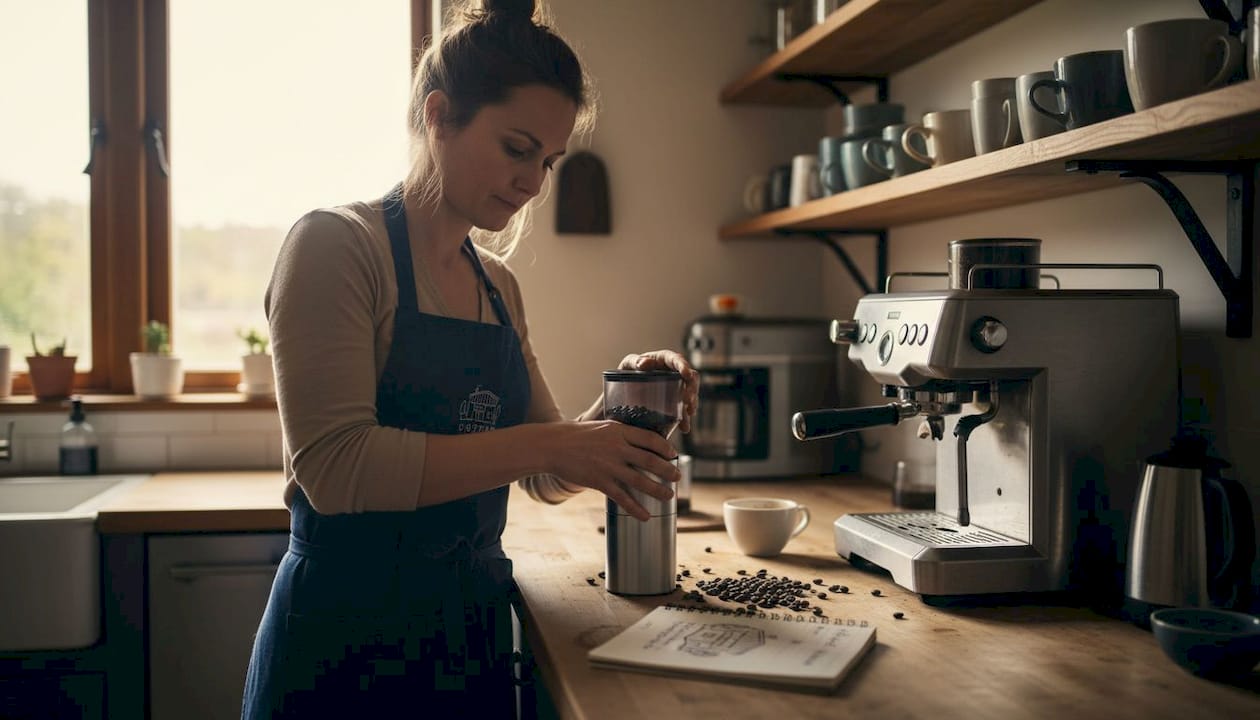
Core brewing at home equipment at a glance:
| Equipment | Purpose | Priority level |
|---|---|---|
| Burr grinder | Consistent grind size for even extraction | Essential (first purchase) |
| Espresso machine | Pressure brewing for espresso | Essential |
| Digital scales | Accurate dose and yield measurement | Essential |
| Tamper | Even coffee bed compression | Essential |
| WDT tool | Breaks up clumps before tamping | Highly recommended |
| Milk thermometer | Accurate steaming temperature | Recommended |
| Knock box | Clean spent puck disposal | Useful |
The WDT tool (Weiss Distribution Technique tool) is a fine-needle instrument that you stir through the loose grounds in the portafilter basket before tamping. This breaks up clumps that would otherwise cause channelling, which is where water finds the path of least resistance through the coffee puck rather than extracting evenly.
For UK homes, space is often a genuine constraint. Many kitchens cannot accommodate a large commercial-style machine and a full grinder setup side by side.
- Choose machines with compact footprints such as the Gaggia Classic Pro or Breville Barista Express.
- Mount a knock box under the counter if possible.
- Store accessories in a single drawer using a compact organiser.
Pro Tip: Read through the coffee shop checklist to identify which accessories add genuine value versus those that are simply appealing to buy. Pair this with the coffee accessories guide to avoid impulse purchases.
Bookmark the quick brew guide for a concise reference when you are mid-brew and need to check a ratio or variable quickly.
Core brewing techniques and methodologies
Equipment is the vehicle. Technique is the driver. Understanding the core parameters behind espresso and filter coffee gives you the ability to troubleshoot any cup, regardless of what beans or machine you are using.
Espresso extraction parameters:
| Parameter | Target range | Effect of deviation |
|---|---|---|
| Dose | 18g (±0.5g) | Lower: weak; higher: over-extracted |
| Yield | 36g out (1:2 ratio) | Lower: intense/bitter; higher: thin/sour |
| Brew time | 25 to 30 seconds | Shorter: under-extracted; longer: over-extracted |
| Water temperature | 93°C to 96°C | Too low: sour; too high: bitter |
| Grind size | Adjusted daily | Finer: slower/stronger; coarser: faster/weaker |
The espresso standard of 18g in, 36g out, over 25 to 30 seconds is a widely accepted starting point for balanced extraction. It is not a rigid rule, but it gives you a reliable baseline from which to adjust.
For filter coffee, the variables differ but the logic is the same. Use a 1:16 ratio for filter and a 1:2 ratio for espresso as your benchmarks. Water temperature should sit between 93°C and 96°C (roughly 199°F to 205°F). The bloom step, which involves pouring a small amount of hot water over the grounds and waiting 30 to 45 seconds before continuing, allows carbon dioxide to escape and results in more even extraction throughout the brew.
Step-by-step approach to dialling in:
- Start with the standard dose and ratio for your chosen brew method.
- Run a shot or brew and note the time and yield precisely.
- Taste critically. Is it sour and thin? Grind finer or increase steep time. Is it bitter and harsh? Grind coarser.
- Adjust one variable only. Changing two at once makes it impossible to identify which affected the result.
- Brew again. Compare. Take notes.
- Repeat until the cup is balanced and pleasant.
Freshness is a critical and often underestimated variable. Beans roasted within one month will behave predictably and taste livelier than stale coffee. Coffee continues to off-gas CO2 after roasting, and beans that are too fresh (within three to five days of roasting) may produce unpredictable results due to excess gas. The sweet spot for most espresso is seven to twenty-one days post-roast.
Pro Tip: Use the quick brew guide alongside a dedicated notebook. Recording your dose, yield, time, and tasting notes for every brew session accelerates improvement significantly. Review your notes weekly and look for patterns.
The home coffee bar setup guide covers practical workspace organisation to keep your brew station efficient and your workflow smooth.
Solving UK home coffee maker challenges
UK home baristas face a specific set of practical obstacles that do not always feature in general brewing guides. Addressing them directly makes the difference between a frustrating setup and a reliable daily routine.
Hard water is the most widespread issue. Much of England sits in hard water regions, particularly London, the South East, and the East Midlands. Hard water contains high levels of calcium and magnesium, which build up as scale inside boilers, group heads, and steam wands. UK hard water causes scaling that shortens equipment life and affects flavour extraction. The practical solution is water filtration, either through a jug filter such as a Brita Maxtra Pro, an in-line filter fitted to the machine, or using a pre-mixed water product such as Third Wave Water.
Channelling is the second most common problem. It occurs when water finds gaps or weak points in the coffee puck and shoots through unevenly, resulting in under-extracted and over-extracted coffee simultaneously. The WDT tool solves this at the preparation stage. Even distribution of grounds before tamping eliminates the majority of channelling cases.
Common UK home brewer challenges and solutions:
- Hard water scaling: Use filtration or purpose-mixed brewing water; descale every three months regardless.
- Channelling: Use a WDT tool before tamping; ensure tamping pressure is level and consistent.
- Grinder heat-up drift: Allow the grinder to warm up for one to two minutes before the first shot; expect a slightly coarser grind setting may be needed as the burrs reach operating temperature.
- Compact kitchen limitations: Invest in a compact machine with a side-mounted steam wand and store accessories vertically using wall-mounted holders.
Pro Tip: The UK brewing tips guide covers water quality and other region-specific considerations that general coffee guides typically overlook.
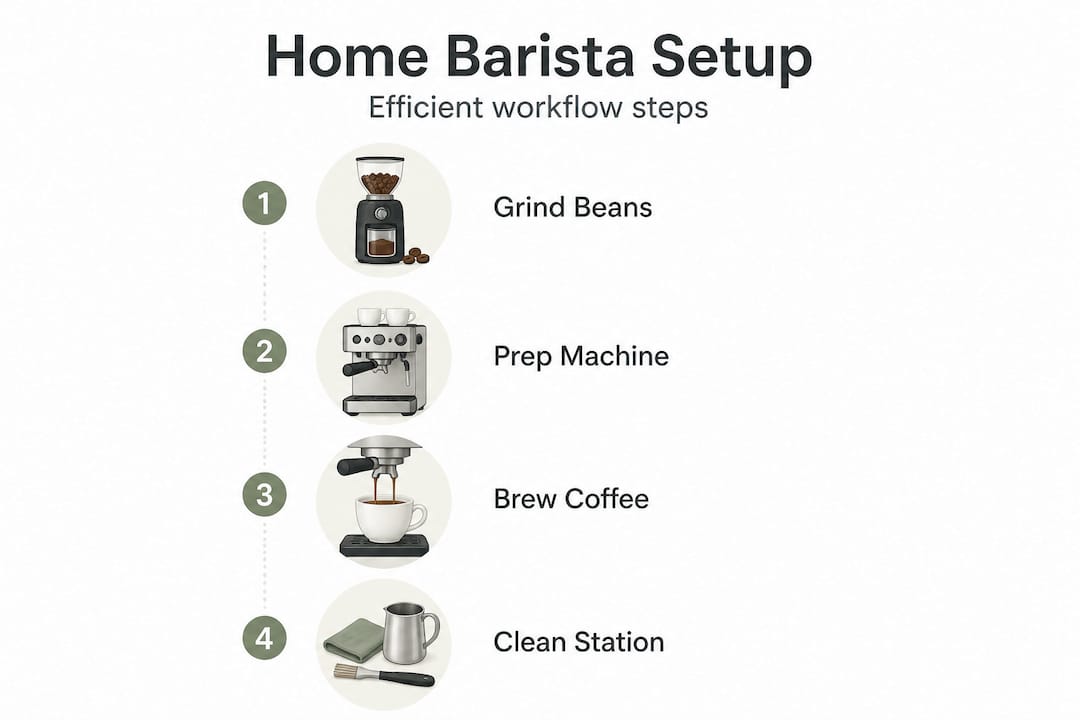
Small UK kitchens also require some creative thinking around workflow. Placing the grinder and machine side by side on a dedicated section of worktop, and keeping scales, tamper, and WDT tool in a single nearby drawer, reduces the friction between steps and helps maintain consistency.
Advanced skills and expert techniques
Once the fundamentals are solid and the common issues are managed, a range of more advanced techniques opens up. These are not shortcuts. They are refinements that build on top of a reliable base.
Bottomless portafilter is one of the most diagnostic tools available. A standard portafilter has a spout that hides the extraction; a bottomless version exposes the underside of the basket, allowing you to observe exactly where and how espresso flows. Uneven or spraying extraction confirms channelling. A tight, centred flow confirms good puck preparation. The bottomless portafilter reveals channelling clearly and helps identify whether the issue is in the grind, distribution, or tamp.
Preinfusion is a technique where water is introduced to the coffee puck at low pressure for three to five seconds before full extraction pressure is applied. This wets the puck evenly before the full 9-bar pressure hits, reducing the risk of channelling and improving consistency. Many semi-automatic espresso machines support this natively or through a needle valve adjustment.
Microfoam for milk-based drinks requires technique and patience. Start with cold milk, approximately 4°C from the fridge. Position the steam wand tip just below the milk surface and angle the jug to create a circular flow. Introduce air with a brief hissing sound at the surface in the first few seconds, then submerge fully and raise temperature to around 60°C to 65°C. The texture should be silky and glossy, not frothy. The microfoam technique aims for a “ripping paper” sound during initial aeration.
Advanced techniques to develop progressively:
- Bottomless portafilter observation and diagnosis.
- Preinfusion adjustment on compatible machines.
- Microfoam for latte art foundations.
- Refractometry for measuring extraction yield precisely.
- Pressure profiling on compatible machines.
“Gear alone is insufficient without technique. Systematic one-variable adjustments and disciplined tasting are what separate consistently good coffee from occasional good luck.”
The coffee accessories guide covers which advanced tools are worth the investment and which are optional extras. Cross-reference this with the quick brew guide to keep your approach grounded in the basics as you add complexity.
What most guides miss about becoming a budding barista in the UK
Most guides focus on gear lists. The conversation very quickly becomes about machines, grinders, and accessories, and very little time is spent on the actual act of tasting and adjusting. This is the real gap in home brewer development in the UK.
The truth is, hard water, small kitchens, and modest budgets force a kind of creative problem-solving that accelerates learning far faster than an unlimited budget ever could. When you cannot simply buy your way to a better cup, you are compelled to develop genuine understanding of what is happening in the puck, in the boiler, and in the cup itself. That understanding is the asset.
UK-specific constraints are genuine advantages in disguise. Managing hard water through filtration teaches you how mineral content affects extraction. Working in a compact kitchen teaches you to streamline workflow. Choosing between a grinder upgrade and a machine upgrade forces you to understand which component genuinely limits your current results. Read the better flavour brewing tips guide for specific adaptations relevant to UK conditions.
The satisfaction of producing a well-balanced shot from a home setup that you have learned, adjusted, and refined is distinct from café coffee precisely because you understand every variable that produced it. Use the home coffee bar setup guide to organise a space that makes daily practice easy and enjoyable. The journey matters as much as the result.
Discover premium UK coffee and barista essentials
Putting good technique into practice requires quality beans. Stale or poorly roasted coffee will undermine even the most dialled-in setup.
The Coffee Factory roasts fresh in Devon and ships directly across the UK, so beans arrive at peak freshness. Browse the full range of unique coffee varieties including single-origin and seasonal selections suited to both espresso and filter brewing. For ongoing freshness and regular discovery, explore coffee subscriptions that deliver freshly roasted coffee on a schedule that fits your routine. Coffee orders over 1kg include free shipping. The coffee brewing guide provides method-specific advice to help you get the most from every bag.
Frequently asked questions
What equipment do I need to start as a coffee enthusiast?
A burr grinder, espresso machine, tamper, scale, and WDT tool are the core essentials for consistent café-quality results. Prioritise the grinder above all other purchases.
How do I dial in espresso as a brewing at home?
Start with 18g dose, 36g yield, 25 to 30 seconds as your baseline, then adjust grind size and taste methodically until the cup is balanced. Change only one variable per session.
Why is burr grinding more important than buying an expensive espresso machine?
A burr grinder ensures consistent grounds that extract evenly, and even the best machine cannot compensate for uneven particle size from a blade grinder.
How does hard water affect home coffee in the UK?
UK hard water causes scaling inside machines and boilers, reduces equipment lifespan, and can skew extraction flavour. Using a water filter or purpose-mixed brewing water resolves both issues reliably.
Are home baristas considered ‘true’ baristas by coffee professionals?
Some professionals argue that home baristas lack commercial volume and therefore the title does not apply, but precision and consistent practice can produce café-quality results regardless of the label.
Taking your skills further: roast level, tamping and practice
Once the basics are in place, the next gains come from adapting your recipe to the coffee in front of you and practising with a bit of structure.
Adjust your recipe for roast level
The 18g in, 36g out recipe works best with medium roasts. Lighter roasts are denser and less soluble, so they usually need water at the top of your temperature range, a longer ratio of around 1:2.2 or more and a slightly longer shot. Darker roasts are more porous and extract quickly, so drop the temperature a few degrees, shorten the ratio towards 1:1.8 and aim for a quicker shot to avoid harsh, ashy flavours. A useful experiment is to brew the same recipe with a light and a dark roast on the same morning. The difference in the cup teaches you more than any table.
Level beats force when tamping
The old advice to tamp with 30 pounds of pressure and finish with a twist is less important than it sounds. Once the pump is pushing at full pressure, any reasonably firm tamp compresses the puck enough. What matters is that the tamp is level. Keep your wrist and elbow in line above the tamper, press straight down without rocking or twisting, and check the surface looks flat before locking in. An uneven puck causes far more channelling than a light tamp ever will.
Practice routines that build consistency
- Side-by-side shots: pull two shots at slightly different grind settings and taste them together. Differences are much easier to spot in direct comparison.
- Blind tastings: ask someone at home to prepare two shots while you taste without knowing which is which. It removes bias and sharpens your palate.
- Recipe hold days: once a week, keep every variable fixed and focus only on repeating your distribution, tamp and timing.
- Taste with someone else: a second palate gives honest feedback and makes practice more enjoyable.
Brewing filter coffee at home
The same principles apply away from the espresso machine. Match grind size to method: coarse for a cafetière, medium for filter and pour-over, fine for espresso or a moka pot. For a cafetière, around 30g of coffee to 500ml of water with a four minute steep is a good start. During the bloom, one or two gentle swirls help settle the bed evenly, but too much stirring speeds extraction and can tip the cup into bitterness.
Is pre-ground coffee worth using?
Grinding just before brewing gives the best aroma, but freshly roasted coffee ground to order and used within a week or so of opening still makes a good cup. The problem is pre-ground coffee that has sat on a shop shelf for weeks. Our coffee is roasted to order in Axminster, Devon, so it reaches you fresh either way.
What if I only have a blade grinder?
Grind in short pulses and shake the grinder between them. It will not match a burr grinder, but it narrows the spread of particle sizes and gives a more even cup until you upgrade.
Recommended
- How to set up a home coffee bar: a practical guide
- Essential coffee shop checklist for home baristas
- Coffee roasting guide: elevate your home brews like a pro
- Brewing guide for every method
- Fresh ground coffee
- Perfect your pour over coffee: A guide for UK enthusiasts
- What is coffee body? understanding its role in flavour