

Essential coffee shop checklist for home baristas
Recreating that perfect coffee shop experience at home can feel overwhelming when you’re faced with endless equipment choices and ingredient options. Home baristas often struggle to identify which tools genuinely matter and which are unnecessary extras. This comprehensive checklist cuts through the confusion, providing you with a clear roadmap to build a setup that consistently delivers café-quality drinks. Whether you’re just starting your home coffee journey or looking to refine your existing setup, you’ll discover the essential items and practical tips needed to transform your kitchen into a personal coffee haven that rivals your favourite local café.
Table of Contents
- Key takeaways
- How to choose equipment for your home coffee shop
- Essential coffee ingredients and accessories for your setup
- Comparing home coffee machines and grinders: a quick guide
- Tips for maintaining your home coffee setup
- Equip your home coffee shop with The Coffee Factory
- Frequently asked questions
Key Takeaways
| Point | Details |
|---|---|
| Choose the right machine | Choosing the right machine across espresso, drip and manual options shapes flavour quality and daily practicality. |
| Grinder quality matters | A good burr grinder produces consistent grind size, improving extraction and overall cup flavour. |
| Key accessories matter | Digital scales and quality tampers help achieve precise coffee to water ratios and even puck compression. |
| Beans and water quality | Fresh beans and well balanced water form the foundation of a great brew. |
| Test by borrowing first | Before buying new gear, borrow or rent different machine types to discover what you genuinely enjoy and will use. |
How to choose equipment for your home coffee shop
Selecting the right coffee machine significantly impacts brewing quality and ease. Your first major decision involves choosing between espresso machines, drip brewers, and manual options. Espresso machines suit those craving lattes and cappuccinos, whilst drip brewers excel at producing larger quantities of filter coffee. Manual methods like pour-over or French press offer complete control over the brewing process and require minimal investment.
Grinder quality deserves equal attention to your brewing device. Consistent grind size directly affects extraction, flavour balance, and overall cup quality. Burr grinders outperform blade models by producing uniform particles, though they command higher prices. Consider whether you need stepless adjustment for espresso or if preset grind settings will suffice for your preferred brewing methods.
Budget constraints naturally influence equipment selection, but kitchen space and desired coffee styles matter equally. Compact machines suit smaller kitchens, whilst larger setups accommodate multiple brewing methods simultaneously. Think about whether you’ll primarily make espresso-based drinks, filter coffee, or want flexibility for both. Your daily coffee consumption also guides capacity requirements.
Key accessories round out your equipment foundation:
- Digital scales for precise coffee-to-water ratios
- Quality tampers for even espresso puck compression
- Milk frothers or steam wands for cappuccinos and lattes
- Gooseneck kettles for controlled pour-over brewing
- Knock boxes for convenient spent puck disposal
Maintenance ease proves vital for long-term satisfaction with your coffee machines. Some models feature automatic cleaning cycles, whilst others require manual backflushing and descaling. Consider how much time you’re willing to invest in upkeep. Machines with removable brew groups simplify cleaning, and transparent water tanks make monitoring levels effortless. Parts availability and warranty coverage protect your investment.
Pro Tip: Before purchasing expensive equipment, borrow or rent different machine types to test which brewing style you genuinely enjoy. This hands-on experience prevents costly mistakes and helps identify features you’ll actually use daily.
Essential coffee ingredients and accessories for your setup
Fresh coffee beans and quality water form the foundation of exceptional home brewing. Whole beans maintain peak flavour for roughly two to three weeks after roasting, whilst pre-ground coffee stales within days. Grinding immediately before brewing releases aromatic compounds at their most vibrant. Purchase beans in quantities you’ll consume within this freshness window rather than bulk buying.
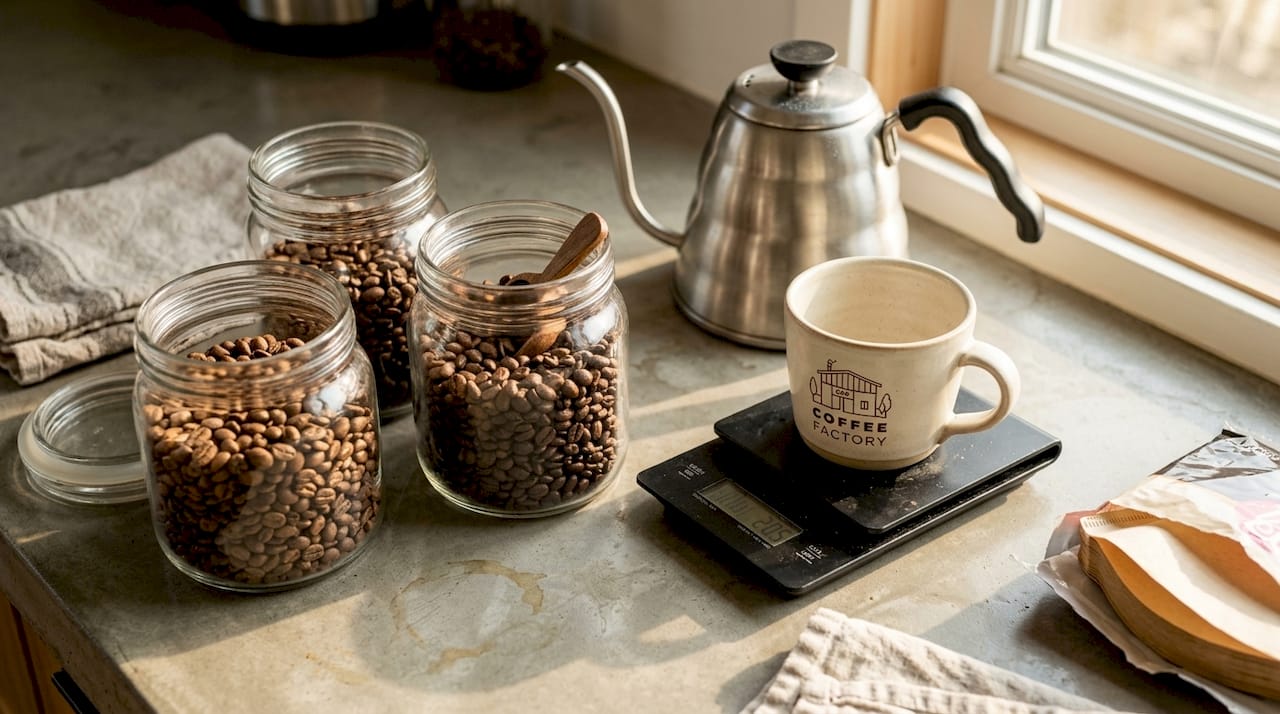
Water quality dramatically influences taste since it comprises over 98% of your final cup. Tap water containing high mineral content or chlorine imparts off-flavours and accelerates machine scaling. Filtered or bottled water with balanced mineral content extracts coffee compounds optimally whilst protecting your equipment. Total dissolved solids between 75-250 ppm generally produce the best results.
Critical accessories enhance precision and consistency:
- Variable temperature kettles for optimal extraction at different brew methods
- Airtight containers with one-way valves for proper bean storage
- Dedicated cleaning brushes for group heads and grinder burrs
- Backflushing detergent and descaling solution
- Microfibre cloths for steam wand maintenance
Milk selection matters significantly for espresso-based drinks. Whole milk froths most reliably due to higher fat content, creating stable microfoam with sweet flavour. Alternative milks vary widely in performance, with barista editions formulated specifically for steaming. Keep milk refrigerated below 4°C and use within recommended dates. Frothing pitchers with temperature strips or separate thermometers ensure you’re heating milk to the ideal 60-65°C range.
Precision brewing tools separate good coffee from exceptional coffee. Digital timers track extraction duration, helping you replicate successful shots and identify variables when results disappoint. Refractometers measure total dissolved solids for advanced users wanting to dial in strength precisely. Shot glasses with measurement markings verify proper yield, whilst distribution tools ensure even tamping pressure across the entire puck surface.
Pro Tip: Store beans in opaque, airtight containers away from light, heat, and moisture. Avoid freezing unless you’re preserving beans beyond three weeks, and never refreeze once thawed. Room temperature storage in a cool cupboard works perfectly for most home setups.
Comparing home coffee machines and grinders: a quick guide
Espresso machines like Sage Barista Express offer all-in-one convenience, whilst manual options provide granular control. Understanding the trade-offs between machine categories helps you select equipment matching your skill level and desired involvement. Automatic machines handle grinding, dosing, tamping, and extraction at button press, though they limit customisation. Semi-automatic models require manual intervention but reward you with greater creative control.
| Machine type | Price range | Best for | Maintenance level | Learning curve |
|---|---|---|---|---|
| Automatic | £400-£2000 | Convenience seekers | Low | Minimal |
| Semi-automatic | £250-£1500 | Engaged hobbyists | Medium | Moderate |
| Manual lever | £300-£3000 | Control enthusiasts | Medium | Steep |
| Pod machines | £50-£400 | Quick drinks | Very low | None |
| Drip brewers | £30-£300 | Filter coffee fans | Low | Minimal |
Grinder selection proves equally crucial for extraction quality. Burr grinders split into conical and flat burr designs, each producing slightly different particle distributions. Conical burrs generate less heat and work quietly, whilst flat burrs deliver exceptional uniformity at higher price points. Stepless adjustment provides infinite grind size control, essential for espresso dialling. Stepped grinders suit filter methods where precision matters less.
| Grinder type | Price range | Grind consistency | Speed | Retention |
|---|---|---|---|---|
| Blade | £15-£40 | Poor | Fast | Low |
| Entry burr | £50-£150 | Good | Moderate | Medium |
| Mid-range burr | £150-£500 | Excellent | Fast | Low |
| High-end burr | £500+ | Outstanding | Very fast | Minimal |
Beginner-friendly options balance ease of use with quality output. The Sage Barista Express espresso machine integrates a capable grinder, reducing counter clutter and simplifying workflow. Breville and De’Longhi offer reliable entry points with intuitive controls. For pure espresso focus, Gaggia Classic Pro provides manual control at accessible pricing.
Budget considerations extend beyond initial purchase. Factor in ongoing costs for cleaning supplies, replacement parts, and potential repairs. Premium machines often feature better build quality and longer warranties, potentially saving money over time. Consider whether you value longevity and repairability or prefer upgrading equipment as your skills develop.
Cleaning requirements vary substantially between machine types. Automatic models with self-cleaning cycles reduce daily maintenance but still need periodic deep cleaning. Manual machines require backflushing and group head scrubbing after heavy use. Grinders accumulate oils and residue, necessitating regular burr cleaning. Machines with removable components simplify this process considerably.
Tips for maintaining your home coffee setup
Regular maintenance of coffee equipment preserves taste quality and extends machine lifespan significantly. Establishing a cleaning routine prevents oil buildup that imparts rancid flavours and protects expensive components from premature failure. Daily tasks take minutes, whilst weekly and monthly maintenance requires slightly more investment but pays dividends in consistent performance.
Daily maintenance focuses on high-contact surfaces. Wipe steam wands immediately after frothing milk to prevent dried residue that harbours bacteria and clogs holes. Purge the wand briefly before and after use to clear internal passages. Rinse portafilters and baskets thoroughly, removing trapped grounds. Empty and rinse drip trays and knock boxes. These quick actions prevent most common issues.
Weekly tasks address less visible accumulation:
- Backflush espresso machines using blind baskets and cleaning detergent
- Remove and soak shower screens and dispersion plates
- Clean grinder burrs with dedicated brushes or grinder cleaning tablets
- Wipe machine exteriors and polish stainless steel surfaces
- Check water filter condition and replace if needed
Monthly descaling removes mineral deposits that restrict water flow and affect temperature stability. Use manufacturer-recommended descaling solutions rather than vinegar, which can damage internal seals and leave lingering odours. Follow specific instructions for your machine model, as procedures vary. Some machines feature automatic descaling programmes, whilst others require manual flushing cycles.
Proper storage prevents contamination and extends equipment life. Keep brewing equipment in clean, dry locations away from excessive heat or moisture. Store portafilters separately rather than locked into group heads, allowing gaskets to relax. Leave machine water tanks partially open to prevent stagnant water issues. Cover grinders when not in use to keep dust and debris from contaminating burrs.
Component inspection catches problems early. Check portafilter baskets for warping or damage that affects extraction evenness. Examine group head gaskets for cracks or compression, replacing them annually or when leaks appear. Test pressure gauges for accurate readings. Verify grinder burr sharpness, as dull burrs generate excessive heat and inconsistent particles. Most burrs last 500-1000kg of coffee before requiring replacement.
Pro Tip: Create a maintenance log tracking cleaning dates, descaling cycles, and part replacements. This record helps identify patterns, ensures you’re not skipping crucial tasks, and proves invaluable for warranty claims or troubleshooting performance issues with customer support.
Equip your home coffee shop with The Coffee Factory
Now that you understand the essential elements of a home coffee setup, it’s time to source quality equipment and ingredients. The Coffee Factory specialises in providing UK home baristas with everything needed to create café-quality drinks. Their curated selection of coffee machines includes options for every skill level and budget, from beginner-friendly semi-automatic models to advanced espresso systems.
Beyond equipment, The Coffee Factory delivers freshly roasted beans directly from their Devon roastery to your door. Their range of unique coffee varieties spans single-origin offerings and carefully crafted blends, all roasted to order for peak freshness. Complement your setup with premium coffee accessories designed to enhance precision and consistency. With free shipping on coffee orders over 1kg and subscription options for regular deliveries, building and maintaining your home coffee shop has never been more convenient.
Frequently asked questions
What is a coffee shop checklist?
A coffee shop checklist is a comprehensive list of equipment, ingredients, and supplies needed to replicate a professional café experience in your home. It ensures you have the right tools for consistently excellent coffee, from machines and grinders to scales and cleaning products. Following a structured checklist prevents overlooking critical items and helps you build a complete setup methodically.
Which coffee machine is best for beginners at home?
Semi-automatic espresso machines with integrated grinders offer the best balance for beginners, providing hands-on learning without overwhelming complexity. The Sage Barista Express exemplifies this category, combining quality components with user-friendly features and clear instructions. These coffee machines allow you to develop barista skills whilst producing impressive results from day one.
How often should I clean my coffee equipment?
Clean grinders weekly using brushes or cleaning tablets to remove oil buildup and stale residue. Espresso machines require daily rinsing of portafilters and steam wands, with backflushing needed after every 20-30 shots or at least weekly. Descale monthly or according to manufacturer guidelines, adjusting frequency based on water hardness. Consistent maintenance prevents flavour contamination and extends equipment lifespan significantly.
Can I use any coffee beans for home espresso?
Espresso extraction works best with fresh, medium to dark roasted beans specifically suited for high-pressure brewing. Light roasts can produce sour, underdeveloped shots, whilst stale beans lack the oils and aromatics essential for rich crema and balanced flavour. Purchase beans roasted within the past two weeks and consume within three weeks of roasting. The Coffee Factory’s unique coffee varieties include options specifically developed for espresso preparation, ensuring optimal results with your home setup.
Recommended
- Elevate Your Home Espresso: Why the Roasters Club Duo Offers the Best
- Quick brew guide
- Coffee Brewing Guide
- Elevate Your Home Brewing: Comparing the Roasters Club Classic vs. Duo
- 7 Essential Steps for Your Specialty Coffee Checklist – House Coffee